

How to Stop Bra Strap Slippage: A Practical Guide
Table of Contents
- Understanding Why Bra Straps Slip
- Signs of a Poorly Fitted Bra
- Check Your Bra Size and Back Band Fit
- How to Measure Bra Size at Home
- Adjusting Strap Length and Strap Placement
- Supportive Bras for Large Busts and Slippage Prevention
- DIY Fixes and Strap Solutions
- Conclusion
- Frequently Asked Questions
Last Updated: August 31, 2026
Understanding Why Bra Straps Slip
Bra strap slippage happens for specific physical reasons. Your shoulders, band tension, and strap placement all work together, when any element is off, straps migrate.
The most common culprit is shoulder slope. Some people have sloped shoulders that naturally angle downward and inward, making straps want to slide off due to gravity (peer-reviewed research). If you've blamed yourself for wearing the wrong size, your shoulders might actually be the real issue.
Band tension matters equally. A band that's too loose shifts around your body, taking the straps with it. Even a well-fitted cup size won't help if the band rides up your back. Fabric stretch is another overlooked factor, elastic degrades over time through daily movement, sweat, and washing (peer-reviewed research).
At Amelie Devizes, we have found that many women who thought they had a size problem actually had a strap placement problem. The difference matters because it changes how you fix it.
Signs of a Poorly Fitted Bra
A poorly fitted bra sends clear signals. Shoulder indentation indicates the band is too tight or straps are positioned too far inward. Constant readjustment means something is wrong with fit, you shouldn't need to adjust a properly fitted bra more than once or twice daily.
The band riding up at the back tells you the band is too loose. A band should sit parallel to the ground all the way around. Spillage at the sides or centre means the cup size is wrong, which is different from strap slippage. Visible bra lines under clothing suggest the band is shifting or straps are positioned incorrectly.
Pay attention to how the bra feels after a few hours of wear. Does it feel looser? Are your straps lower than this morning? These changes indicate the band is stretched out or straps need adjusting.
Check Your Bra Size and Back Band Fit
Getting your size right is the foundation. Many women wear the wrong size without realising it, creating a cascade of fitting problems including strap slippage.
The back band is where most fitting goes wrong. A band that's too loose is the single biggest cause of straps sliding. Your straps are attached to the band, so if the band moves, your straps move. A properly fitted band should sit level all the way around, not riding up at the back.
To check band fit, put the bra on and look in a mirror from the side and back. The band should sit parallel to the ground. If it's higher at the back than at the front, it's too loose. You should be able to fit one finger comfortably under the band all the way around. Two fingers means it's too loose; no space means it's too tight.
When checking fit, wear the bra on the loosest hook. As the elastic stretches over time, you'll move to the middle hook, then the tightest. When you reach the tightest hook and the band feels loose again, that's when you need to replace the bra.
How to Measure Bra Size at Home
You can measure yourself at home, though professional fitting catches nuances self-measurement often misses.
You'll need a soft measuring tape and a mirror. Wear an unpadded bra or no bra.
Measure your band size first. Wrap the tape snugly around your ribcage directly under your bust, where the band would sit. Keep the tape parallel to the ground. Write down this number in centimetres.
Measure your bust next. Wrap the tape around the fullest part of your bust. The tape should be snug but not compressing tissue. Write this down too.
Find your cup size by calculating the difference. Subtract your band measurement from your bust measurement. Each 2.5 centimetre difference equals one cup size (the American Academy of Dermatology). If your bust is 5 centimetres larger than your band, you're a B cup; 7.5 centimetres larger means C cup.
Common measurement mistakes: Measuring over clothes, tilting the tape, measuring too loosely or tightly, or taking measurements at different times of day (breasts change size throughout the day, so measure in the morning).
Even if your measurements suggest a size, try multiple sizes when shopping. Band stretch varies between brands. A size 34B in one brand might fit completely differently than a 34B in another. This is why trying things on matters.
Adjusting Strap Length and Strap Placement
Once you've confirmed your band fits, strap adjustment is your next move. Most bras have adjustable straps for exactly this reason, not everyone's shoulders are the same distance apart or at the same angle.
Locate the adjusters on the back of your bra where the straps meet the band. These are usually small plastic or metal slides. To shorten straps, pull the loose end through the adjuster toward the band. To lengthen them, pull the strap away from the band. Make small adjustments, even a centimetre makes a difference.
The goal is to have straps sit on your shoulders without sliding. They should be snug enough that they don't move when you raise your arms, but not so tight that they dig in. If you've shortened the straps all the way and they still slide, your shoulders are likely sloped and you need a different solution.
Strap placement matters as much as strap length. Straps that are too far apart won't grip your shoulders properly; straps too close together can feel uncomfortable. The ideal placement is roughly shoulder-width apart, though this varies by body. If your straps keep sliding inward, the strap attachment points on the band might be positioned too far inward for your shoulder shape.
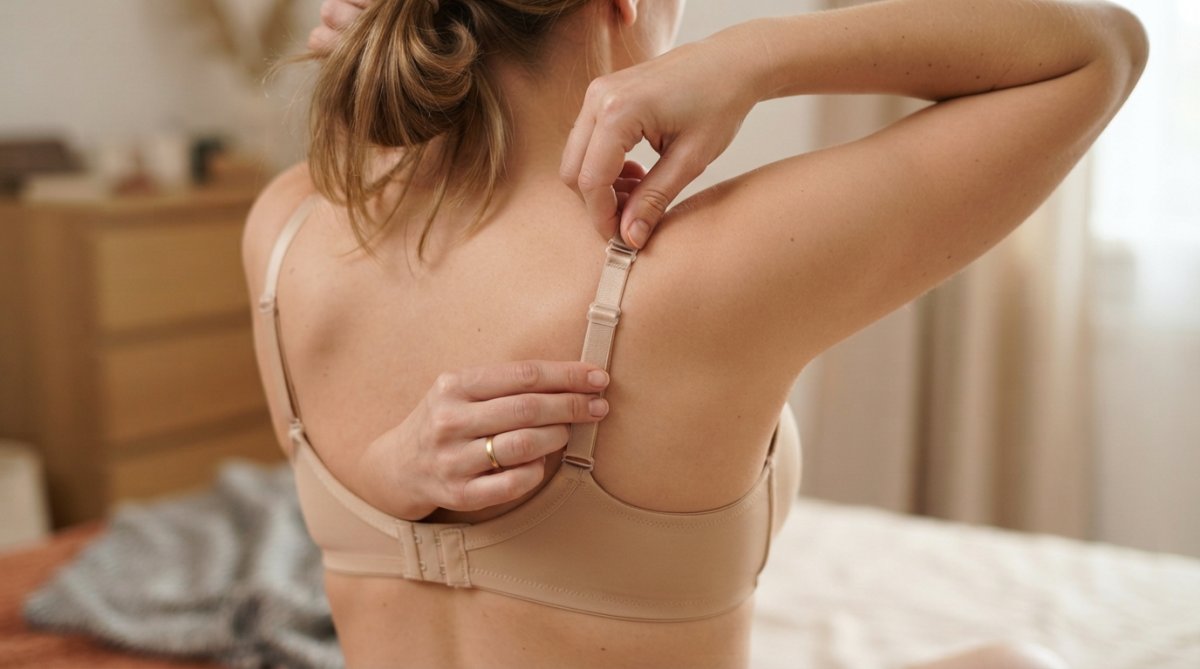
Some bras have fixed straps that can't be adjusted. If you're experiencing slippage with a fixed-strap bra, the strap placement simply doesn't match your shoulder anatomy. In this case, you need either a different bra style or a strap solution like clips or cushions.
The racerback and leotard back styles position straps closer together and at a steeper angle, which works better for sloped shoulders. If traditional straps keep sliding, trying a racerback style is worth the investment.
Supportive Bras for Large Busts and Slippage Prevention
Larger cup sizes need more support, and this changes what prevents slippage. A bra that works for smaller busts often fails for larger ones because weight distribution is completely different.
Underwire bras provide structural support that prevents the entire bra from shifting around. The wire anchors the cup to the band, keeping the band stable and straps in place. For larger busts, underwire is essential for both support and strap stability.
The back band needs to be wider and more structured in larger sizes. A wider band distributes weight more evenly and resists riding up. Three-part cups provide better support for larger breasts and tend to have better strap placement. Full-cup bras cover more breast tissue and provide better support than half-cups or quarter-cups.
Bra extenders can help if you're between sizes or if your band stretches over time. They add extra hook-and-eye closures to the back, effectively making the band larger. Look for bras specifically marketed as "supportive" or designed for larger cup sizes, these will have construction features that prevent slippage.
DIY Fixes and Strap Solutions
If adjusting straps and checking fit haven't solved your problem, several DIY solutions can help.
Bra strap cushions are silicone pads that slide onto your straps. They prevent shoulder indentation by distributing pressure and add grip to prevent slippage. The Model Behaviour Bra Strap Cushions at Amelie Devizes (£6.00) are designed specifically for this. You simply slide your strap into the cushion's channel, and the soft silicone grips both your shoulder and the strap.
Strap clips (also called strap converters) attach straps closer together at the back. They're particularly useful if your straps keep sliding inward or if you have sloped shoulders. Clips are generally affordable.
Bra extenders add extra hook-and-eye closures to your bra's back band. If your band has stretched out or if you're between sizes, an extender makes the band tighter without buying a new bra. They can extend the life of a bra significantly.
Shoulder pads designed for bra wear (like the Bye Bra - Shoulder Bra Pads at Amelie Devizes, £14.95) sit under your bra straps and provide cushioning while adding grip. These pads have a flap pocket where you can secure them under your straps.
Fashion tape or body-safe adhesive can temporarily secure straps to your skin. This is a short-term fix for special occasions, not a daily solution.
Layering strategically can reduce slippage. A fitted tank top or bodysuit under your bra provides friction that helps keep straps in place.
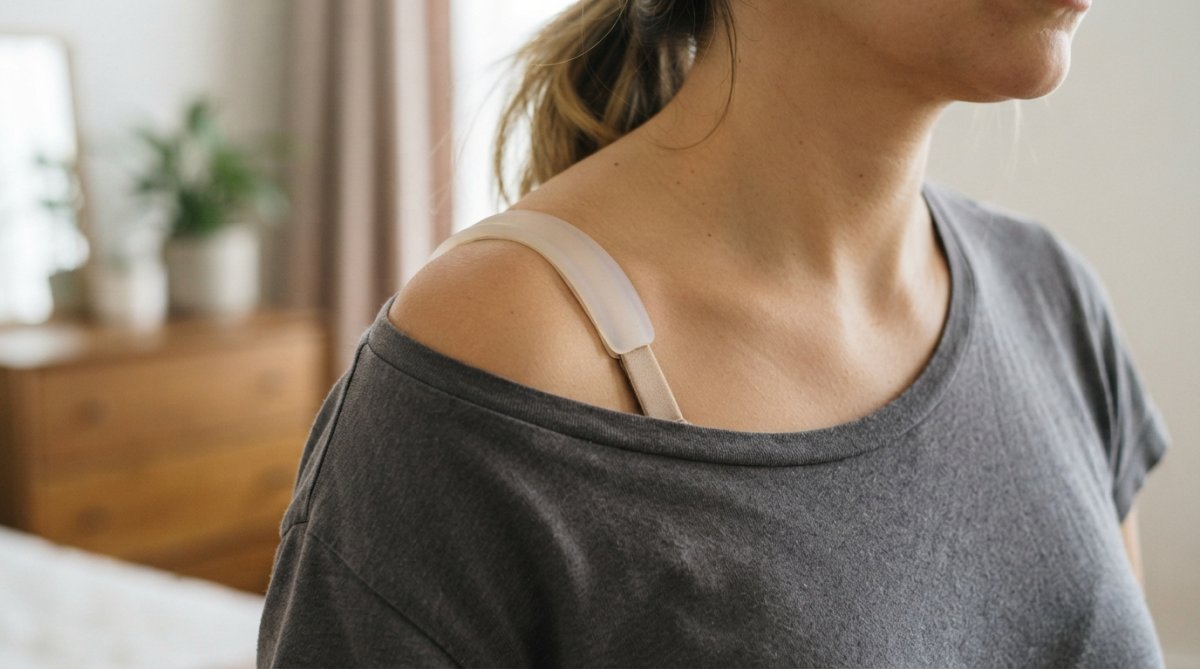
The most effective DIY solution depends on your specific problem. If your issue is shoulder indentation, strap cushions work best. If your straps slide inward, strap clips are your answer. If your band has stretched, an extender buys you time. Many women benefit from combining two solutions.
Professional fitting at Amelie Devizes can identify exactly which solution will work best for your body. Sometimes the answer isn't a product at all, it's simply a different bra style or size that works with your anatomy instead of against it.
Conclusion
Bra strap slippage is solvable, but the solution depends on why it's happening. Is your band too loose? Are your shoulders sloped? Has the elastic worn out? Each cause has a different fix.
Start by checking your band fit and strap adjustment. These are free and often solve the problem immediately. If slippage persists, try one of the affordable DIY solutions. Strap cushions and clips are generally affordable and work for most people.
When you're ready for a more permanent solution, professional fitting makes a real difference. At Amelie Devizes, our fitting service identifies the exact cause of your slippage and recommends bras designed for your specific shoulder anatomy and support needs. We specialise in finding bras that work with your body, not against it, whether you need supportive styles for larger busts, racerback designs for sloped shoulders, or post-surgery bras that combine comfort with security. Many women discover they've been wearing the wrong size or style for years, and the right fit transforms not just comfort but confidence. Shop all products at Amelie Devizes and discover how the right bra should actually feel.
Bra strap slippage doesn't have to be a constant frustration. Whether you need strap cushions for immediate relief, a bra extender to make your current bras work better, or professional fitting to find your perfect size and style, Amelie Devizes has solutions designed to keep you comfortable and supported. Our expert fitting service and carefully curated selection of supportive bras mean you'll finally find pieces that stay in place and make you feel confident all day. Get started with Amelie Devizes and experience the difference proper fit makes.
Frequently Asked Questions
Q: Why does my bra strap keep slipping off my shoulder?
A: Bra strap slippage typically happens when your back band is too loose, your cup size is too small, or your shoulder slope is steep. If the band rides up at the back, the straps move inward and slip off sloped shoulders. Check that your band sits level and parallel to the ground at the back. If it tilts upward, you need a smaller band size. Strap placement and elasticity also matter, worn-out elastic loses tension and won't hold straps in place.
Q: How do I know if I have a signs of a poorly fitted bra?
A: A poorly fitted bra shows several clear signs: straps slide off your shoulders, the back band rides up, cups gap or overflow, the underwire pokes or sits away from your ribcage, or you experience shoulder indentation and discomfort. The band should sit level around your torso, not dig in or feel loose. Cups should fully enclose breast tissue without spillage. If you're adjusting straps constantly or experiencing pain, your bra doesn't fit correctly and a professional fitting can identify the right size.
Q: Can strap cushions really stop bra strap slippage?
A: Strap cushions help prevent slippage by adding grip and reducing friction between the strap and your skin. Products like Model Behaviour Bra Strap Cushions (£6.00) use soft silicone channels that hold straps in place while eliminating shoulder grooves and discomfort. They work best when your bra size is correct, they're a comfort aid, not a fix for an ill-fitting bra. If your band is too loose or your cup size is wrong, cushions alone won't solve the underlying problem.
Q: What's the fastest way to stop strap slippage temporarily?
A: For immediate relief, try strap clips (small devices that hook straps together at the back), fashion tape on your skin under the strap, or a bra extender if your band is slightly too loose. Layering a fitted tank or camisole underneath can anchor straps. For a permanent solution, adjust your strap length shorter using the fasteners on the back band, or get professionally fitted to ensure your band and cup size are correct.
This article was written using GrandRanker