

How to Find Your Correct Bra Size: A 2026 Guide
Table of Contents
- What You'll Need Before You Start Measuring
- How to Find Your Correct Bra Size: Band and Bust Measurements
- Bra Size Calculator UK: Using the Formula at Home
- Signs Your Bra Doesn't Fit (and What Each One Means)
- Sister Sizes Explained: When Your Usual Size Isn't Available
- Why Standard Sizing Doesn't Work for Every Body
- How to Find Your Correct Bra Size with a Professional Fitting
- Conclusion
Last Updated: August 9, 2026
What You'll Need Before You Start Measuring
Getting your correct bra size starts long before you touch a tape measure. Here is what you actually need:
- A soft fabric tape measure (the kind used for dressmaking, not a rigid metal one)
- A well-fitting, non-padded, non-underwired bra to wear during measurement, or no bra at all
- A mirror, or a friend to help you read the tape accurately from behind
- A pen and paper to note both measurements down
The non-padded bra detail matters more than people realise. Padded cups add volume that skews your bust measurement, which then throws off your cup calculation entirely. If you only own padded bras right now, measuring without a bra gives a more accurate result.
Measurements taken first thing in the morning tend to be more stable than those taken after a long day, when fluid retention can affect your results. Stand upright with relaxed shoulders and breathe normally. Holding your breath or tensing your muscles changes the numbers.
How to Find Your Correct Bra Size: Band and Bust Measurements
Finding your correct bra size comes down to two measurements taken in the right way, then a straightforward calculation. The process takes under five minutes, but the difference it makes to comfort and support is significant.
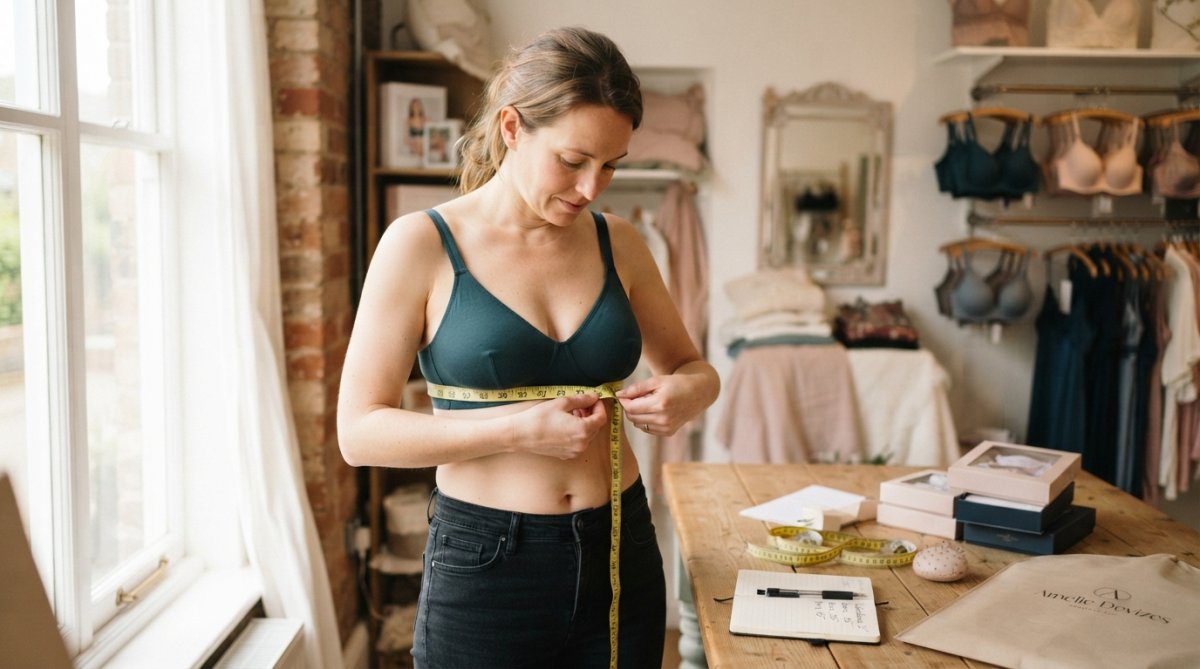
Step 1: Measure Your Band Size
Wrap the tape measure firmly around your ribcage, directly underneath your bust. The tape should sit parallel to the floor all the way around, and feel snug but not tight. You should be able to slide two fingers underneath it comfortably.
Note this number in centimetres. UK band sizes run in even numbers: 28, 30, 32, 34, 36, 38, 40, and so on. If your measurement falls on an even number, that is your band size. If it falls on an odd number, round up to the nearest even number. So a 33cm ribcage measurement becomes a 34 band.
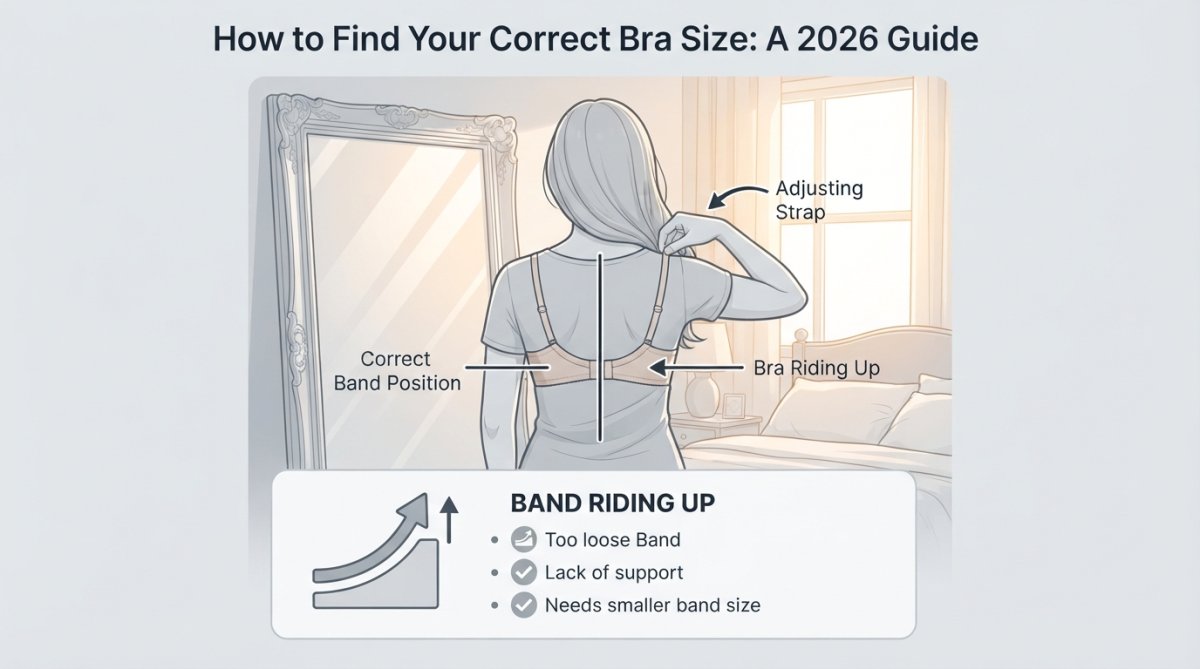
The band is the foundation of the entire bra. A loose band means the bra rides up at the back, the underwire sits away from the body, and the straps carry all the weight. Straps are not designed to provide primary support. The band is.
Step 2: Measure Your Bust Size
Keep the tape measure parallel to the floor and wrap it around the fullest part of your bust. This is usually across the nipple line, though the fullest part varies with breast shape. Do not pull the tape tight here. It should sit smoothly against the skin without compressing the tissue.
Note this measurement in centimetres. You now have both numbers you need.
Step 3: Calculate Your Cup Size
Subtract your band measurement from your bust measurement. The difference, in centimetres, corresponds to a cup size.
| Difference (cm) | Cup Size |
|---|---|
| Less than 1 cm | AA |
| 1 cm | A |
| 2-3 cm | B |
| 4-5 cm | C |
| 6-7 cm | D |
| 8-9 cm | DD (E) |
| 10-11 cm | E (F) |
| 12-13 cm | F (FF) |
| 14-15 cm | G |
| 16 cm+ | GG and above |
So if your band measures 34 and your bust measures 40, the difference is 6cm, which gives you a D cup. Your size is 34D.
Bra Size Calculator UK: Using the Formula at Home
A bra size calculator UK tool works by taking your band measurement, your bust measurement, and calculating the difference to produce a starting size. The formula is the same whether you use a paper chart or an online calculator.
The starting size is not always the final size. According to guidance from the British Standards Institution on clothing size labelling, there is no single universal standard that all UK lingerie brands are required to follow, which means sizing can vary between manufacturers. A 34D in one brand may fit differently from a 34D in another.
Use the calculated size as your starting point, then apply a fit check before committing to it. If you are between sizes, try both and assess which one passes the fit check criteria. Online bra size calculators are useful for getting a ballpark figure, but they cannot account for breast shape, tissue density, or how a specific bra's construction interacts with your body.
Signs Your Bra Doesn't Fit (and What Each One Means)
The most reliable fit check is what you see and feel when you put the bra on.
The band rides up at the back. This means the band is too loose. A correctly fitted band should sit parallel to the floor, level with the underwire at the front.
The underwire digs into breast tissue. The underwire should sit flat against your ribcage and follow the natural crease where your breast meets your torso. If it is sitting on breast tissue rather than around it, the cup is too small or the shape is wrong for your frame.
The cups gape or wrinkle. Gaping fabric at the top of the cup usually means the cup is too large, or the style does not suit your breast shape.
Spillage over the top or sides. If breast tissue is escaping over the top of the cup or pushing out under the arms, the cup is too small. This is the most common fitting error.
The gore does not lie flat. The gore is the central panel between the cups. It should sit flush against your sternum. If it is floating away from your body, the cups are too small or the style is not right for a close-set breast shape.
Straps digging in or falling off. Straps that dig into shoulders are carrying too much weight, which points back to a band that is too loose. Straps that fall off constantly suggest the back is too wide for your frame size.
Shoulder tension and back discomfort. Persistent shoulder tension and upper back pain are often linked to poor bra support. A correctly fitted band distributes weight across the ribcage, not the shoulders.
Sister Sizes Explained: When Your Usual Size Isn't Available
Sister sizes are the most underused tool in bra fitting, and once you understand them, they genuinely expand your options.
Every bra size has sister sizes: adjacent sizes that share the same cup volume but with a different band. Moving one band size up and one cup size down gives you the same cup volume. Moving one band size down and one cup size up also gives the same cup volume.
Sister sizes for 34D:
- 32DD (smaller band, same volume)
- 36C (larger band, same volume)
This matters when your size is out of stock in a style you love, or when you are between band sizes. If a 34 band feels slightly loose but a 32 feels too firm, a 32DD gives you the firmer band with the same cup space.
Sister sizes share cup volume, but the fit experience is not identical. A 32DD will have a narrower frame and shorter underwire than a 34D. For women with a wider ribcage or broader breast root, the 32DD may feel too narrow even though the volume is technically the same.
Why Standard Sizing Doesn't Work for Every Body
Standard bra sizing assumes a relatively uniform breast shape and tissue distribution. Most bodies do not fit that assumption, which is why so many women find that their "correct" calculated size still does not feel right.
Breast Shape and Tissue Density
Breast tissue varies considerably in density and distribution. Denser, firmer tissue tends to hold its shape within a cup more easily. Softer, more pliable tissue may migrate under the arm or toward the centre, meaning a standard cut cup leaves gaps at the top while the tissue sits lower.
Breast shape also varies in ways that affect fit significantly:
- Full on top: More volume in the upper portion of the cup. Balconette and plunge styles often gape at the top for this shape.
- Full on bottom: More volume below the nipple line. Balconette styles often suit this shape better than full-cup styles.
- Wide-set: Breasts sit further apart on the chest. A low-gore style prevents the central panel from floating away from the sternum.
- Close-set: Breasts sit close together. A higher gore or full-cup style may cause the gore to dig in.
- Shallow: Less projection from the chest wall. Moulded cups often leave a gap at the top because they are designed for more projected shapes.
No calculator can assess these variables. The difference between a calculated size and a comfortable fit is often not the numbers themselves, but the style and construction of the bra.
Fitting Across Life Stages
Breast tissue changes throughout life, and a bra size that fitted well at one stage may be completely wrong at another. Many women are still wearing a size they were measured for years ago.
Key life stages that shift fit requirements:
- Puberty and early adulthood: Breast tissue is still developing. Sizing needs reassessment every six to twelve months.
- Pregnancy and nursing: Cup size can increase by several sizes. Band size also changes as the ribcage expands. Maternity and nursing bras are constructed differently to accommodate these changes and allow easy feeding access.
- Perimenopause and menopause: Hormonal changes affect breast tissue density and distribution. Many women find their shape changes more than their size, requiring a different style even if the measurement stays similar.
- Post-surgery: Whether following mastectomy, lumpectomy, augmentation, or reduction, standard sizing categories may not apply. Specialist post-surgery bras are designed with different construction principles to prioritise comfort, scar coverage, and support without pressure on sensitive areas.
How to Find Your Correct Bra Size with a Professional Fitting
Self-measurement gives you a useful starting point, but a professional fitting gives you something a tape measure cannot: an expert eye assessing shape, projection, tissue distribution, and how a specific bra's construction interacts with your body.
A professional fitter observes how the bra sits, identifies whether the underwire is following the correct path, checks that the gore lies flat, and assesses whether the cup shape suits your breast shape. They can also recommend styles based on what they see, rather than what a calculator produces.
At Amelie Devizes, professional bra fitting is central to everything we do. Our fitting service is designed to be a genuinely comfortable experience, particularly for women who have found high street fittings rushed or impersonal. We work with women at every life stage, including bridal fittings for those planning their wedding day look, and specialist post-surgery fittings for women navigating recovery. The environment is warm, unhurried, and entirely non-judgmental.
As the Chartered Society of Physiotherapy's guidance on posture and supportive garments notes, properly supportive undergarments play a meaningful role in reducing shoulder and back strain, particularly for women with larger cup sizes. Getting the fit right has real physical implications.
For women who have had previous poor experiences with fitting services, or who have never had a professional fitting before, the process at a specialist boutique is genuinely different from a rushed measuring session in a department store changing room. There is no pressure, no hurry, and no assumption that you already know what you are looking for.
Finding the correct bra size is one of those things that sounds simple until you try to do it properly, and then realise how many variables are involved. Self-measurement is a solid starting point, but it rarely tells the whole story. If you have been living with discomfort, persistent back pain, or bras that never quite feel right, the answer is usually not a different size on a chart. It is a fitting with someone who knows what they are looking at. Amelie Devizes offers expert, personalised bra fitting in a welcoming boutique environment, with specialist services for bridal, maternity, and post-surgery needs. Book a fitting or browse our full collection to find pieces that genuinely work for your body.
Frequently Asked Questions
How do I calculate my correct bra size at home?
Measure your band size by wrapping a soft tape measure snugly around your ribcage, just beneath your bust, and rounding to the nearest even number. Then measure the fullest part of your bust, keeping the tape parallel to the floor. Subtract your band measurement from your bust measurement; each centimetre of difference corresponds to a cup size on UK sizing charts. For example, a 2.5 cm difference is roughly an A cup, 5 cm a B cup, and so on. Always measure in a non-padded bra for accuracy.
Is a 36C bigger than a 34C in UK sizing?
Yes, a 36C has a larger cup volume than a 34C, even though both carry the letter C. Cup size is always relative to band size, not an absolute measurement. A 36C and a 34D are sister sizes, they hold a similar volume of breast tissue, but the band width differs. This is why two women wearing the same cup letter can look and feel very different in the same style. Always assess band and cup together when checking your correct bra size.
How should a correctly fitted bra feel?
The band should sit snug and level all the way around, parallel to the floor, without riding up at the back. You should be able to slide two fingers beneath it but no more. The underwire should sit flat against your ribcage and fully encircle your breast tissue without digging. Cups should be smooth with no spillage or gaping. Straps should stay in place without digging into your shoulders. If you feel any tension, pinching, or the bra shifts during the day, the fit needs adjusting.
How often should I remeasure my bra size?
Remeasure at least once a year, and any time your body changes significantly, including weight fluctuation, pregnancy, breastfeeding, post-surgery recovery, or hormonal shifts such as perimenopause. Bra size can change several times over a lifetime, and even a small shift in band or bust measurement can mean a different size entirely. Many women find their size changes more often than they expect, which is why regular fit checks, whether at home or with a professional fitter, make a noticeable difference to comfort and support.
This article was written using GrandRanker