

Book a Professional Bra Fitting: Step-by-Step Guide
Table of Contents
- Why Book a Professional Bra Fitting Service
- Signs Your Bra Doesn't Fit Properly
- How to Measure Your Bra Size at Home
- What to Expect at a Bra Fitting Appointment
- How to Book Your Professional Bra Fitting
- Specialist Fitting Services for Specific Needs
- In-Store vs. Online Fitting Options
- Conclusion
Last Updated: August 13, 2026
Why Book a Professional Bra Fitting Service
Most women wear the wrong bra size, often by several sizes. A professional bra fitting corrects this fundamental mismatch, transforming comfort, support, and confidence in ways that off-the-rack shopping cannot achieve.
At Amelie Devizes, we understand that finding your perfect fit goes beyond numbers on a tag. A proper professional bra fitting addresses your body's specific contours, lifestyle needs, and personal preferences. Whether you're experiencing chronic back pain, struggling with spillage or gaps, or simply want to feel more supported, a fitting appointment delivers clarity that self-measurement rarely provides.
A professional fitter observes how a bra sits on your unique frame, how straps position themselves, whether the gore (the centre panel) lies flat against your breastbone, and whether the band sits level all the way around. These details require trained eyes and hands-on adjustment.
Signs Your Bra Doesn't Fit Properly
Your bra sends constant signals about fit. Learning to read them prevents months of discomfort and poor support.
The band rides up at the back. A band that climbs toward your shoulder blades means it's too large. The band should sit parallel to the ground all the way around. If you constantly pull it down, the band size needs to decrease.
Straps slip off your shoulders. Slipping straps indicate either a band that's too loose or cups that are too large, allowing the entire bra to shift downward.
Spillage above or below the cup. Spillage above the cup (sometimes called "quad boob") means the cup is too small. Spillage below suggests the cup is too large and the breast tissue is settling lower than intended.
Wires sit on breast tissue instead of in the breast fold. The underwire should sit in the natural crease where your breast meets your torso. If it digs into breast tissue, the cup is too small. If it sits too far below, the cup is too large or the band is too loose.
The gore doesn't lie flat. The gore is the vertical centre panel connecting the two cups. It should touch your breastbone without gaps. A gap indicates cups that are too large or too far apart.
Back pain or shoulder discomfort. Chronic back or shoulder pain often traces to an unsupportive or poorly fitted bra. An oversized band forces shoulder straps to compensate, creating tension.
You adjust your bra throughout the day. Constant readjusting signals that something isn't right. A well-fitted bra should feel stable and require minimal attention.
How to Measure Your Bra Size at Home
While a professional fitting is ideal, understanding your measurements provides a useful starting point and helps you communicate with a fitter.
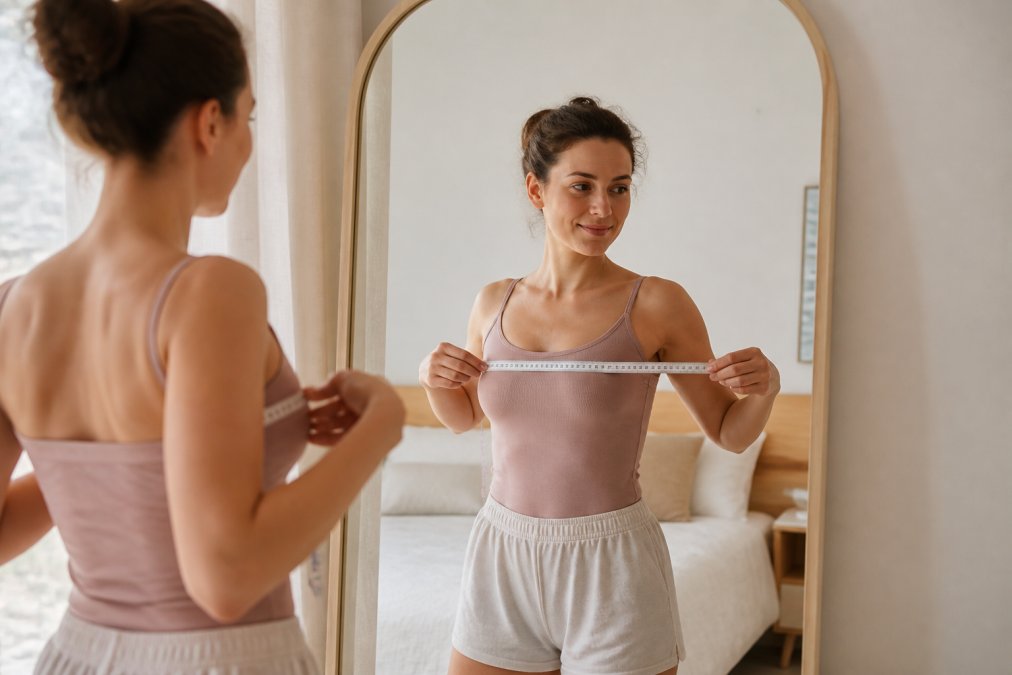
What you'll need: A soft measuring tape, a mirror, and comfortable clothing or no bra at all.
Measure your band size. Stand straight and measure snugly around your ribcage directly under your bust, keeping the tape parallel to the ground. This measurement in centimetres is your band size. If you measure 80 centimetres, your band size is 80.
Measure your bust. Measure loosely around the fullest part of your bust, keeping the tape level without compressing tissue.
Calculate your cup size. Subtract your band measurement from your bust measurement. Each 2.5 centimetres of difference roughly equals one cup size: 2.5 centimetres is an A cup, 5 centimetres is a B cup, 7.5 centimetres is a C cup, and so on. If your band is 85 centimetres and your bust is 92.5 centimetres, the difference is 7.5 centimetres, suggesting a C cup (size 85C).
Account for asymmetry. Many women have slightly different breast sizes. If one side measures a full 2.5 centimetres larger than the other, note this for your fitter.
Remember: this is a starting point. Home measurements provide useful information, but they don't account for shape, projection, or how a bra sits on your specific body. A professional fitter will use these measurements as a baseline and adjust based on how different styles actually fit you.
What to Expect at a Bra Fitting Appointment
The measurement process
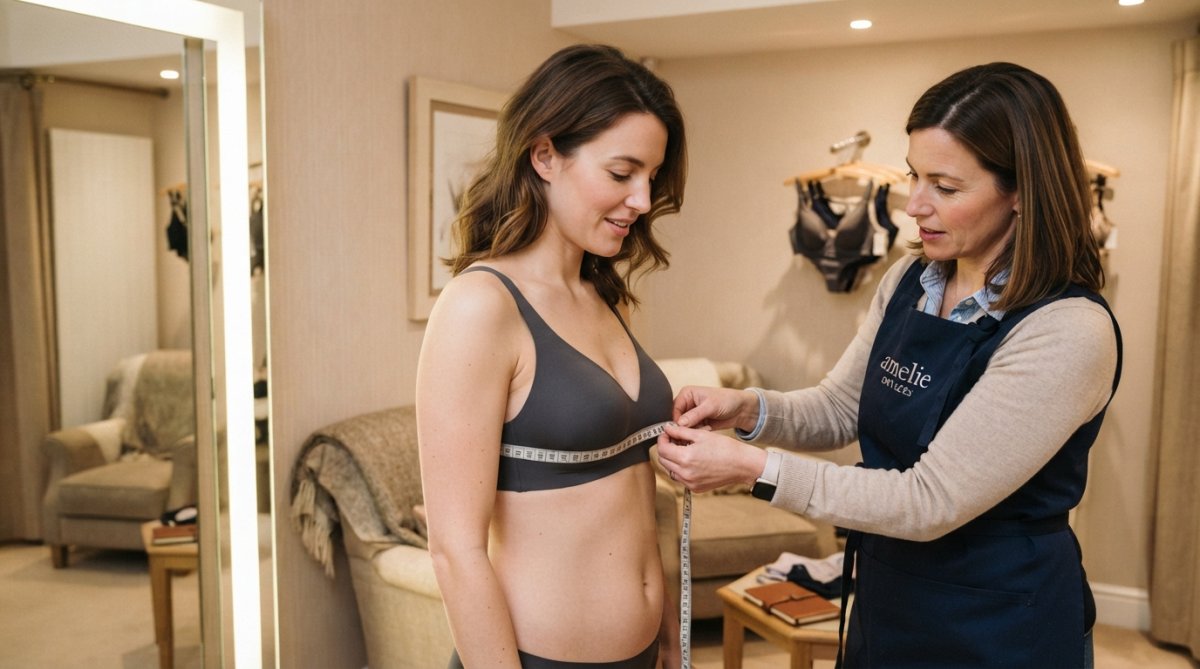
A professional bra fitting begins with measurement, but it's far more nuanced than a tape measure alone. Your fitter will measure your band and bust, then assess your shape, projection, and tissue distribution. We don’t use a tape measure, nor do we use the term “measure”, In fact, if you come in asking for a measurement, we will tell you that we “fit”!
The fitter observes how your breasts sit naturally on your ribcage. Some women have tissue that sits high and close together; others have tissue that sits lower or wider apart. These shape characteristics determine which bra styles will work best for you, regardless of your size number.
Your fitter will ask about your current bra size and any fit issues you've experienced. This conversation is invaluable, it tells them whether you've been wearing too large a band, cups that are too shallow, or styles that don't suit your shape.
Trying on styles and sizes
In other stores, once measurements are complete, the real fitting begins. In our boutique, this happens straight away. Your fitter, myself, brings several options in your estimated size and nearby sizes. You'll try on different styles, balconette, full cup, plunge, minimiser, or others, and your fitter will assess how each one sits on your body.
A proper fitting involves checking multiple points: Does the gore lie flat? Do the straps sit where they should? Is the band level all the way around? Does the cup contain all your tissue without gaps or spillage? How does the bra feel when you move, raise your arms, or bend forward?
Your fitter may suggest sister sizes, alternative band and cup combinations that provide the same cup volume but in a different band size. For example, an 85C and an 80D are sister sizes. If an 85C feels too loose in the band, an 80D might provide better support while maintaining the same cup volume.
Try on at least three to five options. The goal is to understand what works for your body and why.
How to Book Your Professional Bra Fitting
Step 1: Choose your fitting location
Decide whether you prefer an in-store appointment or a virtual fitting. In-store fittings allow your fitter to physically assess how bras sit on your body and make real-time adjustments. Virtual fittings offer convenience and privacy, though they rely on images or video to assess fit.
Boutique fitters like Amelie Devizes provide a warm, inclusive environment where you can feel comfortable and unhurried. Consider what matters most to you: expertise in your particular needs, location accessibility, or range of brands available.
Step 2: Check appointment availability
Contact your chosen fitting location to check availability. Many boutiques accept both appointments and walk-ins, though booking ahead ensures you receive dedicated time with a fitter.
Ask about any preparation steps they recommend. Some fitters suggest wearing a bra you currently find comfortable so they can assess your current fit. Others prefer you wear no bra so they can assess your natural shape.
Step 3: Prepare for your appointment
Wear comfortable, easy-to-remove clothing. Avoid heavily padded bras or shapewear, as these distort your natural shape and make accurate fitting difficult.
Arrive with a clear sense of your needs. Are you seeking everyday comfort? Support for a specific activity? A bra for a special occasion? Do you have any fit concerns or physical considerations your fitter should know about?
Bring a list of any brands you've worn successfully. If you've had a previous fitting elsewhere, mention it, your fitter can build on that knowledge or correct any issues.
Specialist Fitting Services for Specific Needs
Bridal bra fitting
A bridal bra must provide invisible support under your wedding dress while keeping you comfortable throughout a long day. Your fitter will consider your dress's neckline, back design, and fabric, recommending styles that won't show straps or create visible lines under your dress.
Post-surgery bra fitting
After breast surgery, your body needs specialised support. A post-surgery bra provides gentle compression, avoids pressure on surgical sites, and accommodates changes in shape or sensation. A professional fitter experienced in post-surgery needs understands these requirements and knows which brands specialise in post-surgery designs.
Maternity and nursing bra fitting
Pregnancy and nursing transform your breasts. A maternity bra accommodates growing breast tissue during pregnancy. A nursing bra provides easy access while maintaining support and comfort. A professional fitting considers how your body is changing and what you'll need at different stages.
In-Store vs. Online Fitting Options
In-store fittings provide hands-on assessment. Your fitter can observe how bras sit on your body, make physical adjustments, and assess comfort through conversation and observation. You can try on multiple styles immediately and walk out with your purchase. Your fitter can also show you techniques like the "scoop and swoop", a method for properly positioning breast tissue within the cup.
Online fittings offer convenience and privacy. You submit measurements and images, and a professional fitter reviews them and provides recommendations. Some services offer video calls for real-time discussion.
Online fittings work well if you're comfortable with your body being assessed through images, you know your approximate size, or you live far from a physical fitting location. They're less ideal if you have significant shape asymmetry, have never been professionally fitted, or prefer hands-on guidance.
Many boutiques, including Amelie Devizes, offer both options. Choose based on your comfort level, location, and scheduling needs.
Finding your perfect fit transforms how you feel in your body. A professional bra fitting reveals your true size, identifies styles that work for your shape, and addresses fit issues that have caused discomfort for years. At Amelie Devizes, our expert fitters provide personalised guidance in a warm, inclusive environment, whether you're seeking your first professional fitting, preparing for a special occasion, or managing specialist needs like post-surgery support. Proper bra fit has been shown to improve posture and reduce shoulder tension. Book your appointment today and discover how the right fit can change everything.
Frequently Asked Questions
What should I wear to a professional bra fitting?
Wear comfortable clothing that's easy to remove and put back on, such as a loose top or button-up shirt. Avoid tight layers. Many fitters recommend wearing an unpadded bra or no bra so they can assess your natural shape. Bring a few bras you currently wear so the fitter can see what you're used to and identify fitting issues.
How do I know if I need a professional bra fitting?
Signs your bra doesn't fit include straps that slip, underwire that digs in, back band that rides up, or cups that wrinkle or overflow. Many women wear the wrong size for years without realising. A professional bra fitting uses proper measurement techniques and expert assessment to find your true size and style, ensuring comfort and support that mass-market retailers often miss.
Can I get a bra fitting online or do I need to visit in person?
Both options are available. In-store fittings offer hands-on assessment and the chance to try multiple styles immediately. Virtual fittings work well if you prefer privacy or convenience; some services use video calls or photo submissions for assessment. Choose based on your comfort level and whether you want to take bras home the same day or prefer the flexibility of home-based consultation.
How often should I get a professional bra fitting?
Most experts recommend a professional bra fitting every 1-2 years or whenever your body changes significantly (weight fluctuation, pregnancy, post-surgery recovery). Your band size and cup size can shift due to hormonal changes, ageing, or life events. Regular fittings ensure you're wearing the correct size and that your bras provide optimal support and comfort throughout different life stages.
This article was written using GrandRanker