

Supportive Bras for Large Busts: 2026 Guide
Table of Contents
- What Makes Supportive Bras for Large Busts Actually Work
- Signs Your Bra Doesn't Fit Properly
- How to Measure Bra Size at Home
-
Best Supportive Bras for Large Busts: Our Top Picks by Style
- Best Full Cup: Panache Envy Full Cup Bra
- Best for Side Support: Curvy Kate WonderFully Full Cup Side Support Bra
- Best for Plunge Necklines: Fantasie Fusion Lace Padded Plunge Bra
- Best T-Shirt Bra: John Lewis Sofia Smooth Underwired T-Shirt Bra
- Best Sports Bra: Elomi Energise High Impact Underwire Sports Bra
- Best Luxury Everyday: Wacoal Back Appeal Classic Underwire Bra
- Best Non-Wired Bras for Large Busts
- Wired vs. Wire-Free: Which Gives Fuller Busts Better Support?
- Why a Professional Bra Fitting Changes Everything
- Conclusion
Last Updated: August 11, 2026
Finding supportive bras for large busts is genuinely harder than most guides acknowledge. The difference between a bra that causes shoulder grooves and back pain by midday and one that feels almost invisible comes down to specific structural details that mass-market lingerie rarely gets right. At Amelie Devizes, we work with women at every stage of their bra-fitting journey, and the same principles apply every time: fit, construction, and the right style for the right body.
Quick Picks:
- Best Full Cup: Panache Envy Full Cup Bra, exceptional lift and separation for D-K cups
- Best Side Support: Curvy Kate WonderFully Full Cup Side Support Bra, prevents spillage and centres the bust
- Best Plunge: Fantasie Fusion Lace Padded Plunge Bra, low neckline without sacrificing containment
- Best T-Shirt Bra: John Lewis Sofia Smooth Underwired T-Shirt Bra, seamless under close-fitting tops
- Best Sports: Elomi Energise High Impact Underwire Sports Bra, built for high-impact activity at D-KK
- Best Luxury Everyday: Wacoal Back Appeal Classic Underwire Bra, sophisticated smoothing with quality craftsmanship
- Best Wire-Free: Royce Grace 513 Cotton Rich Non-Wired Bra, gentle support ideal for sensitive skin and post-surgery wear
What Makes Supportive Bras for Large Busts Actually Work
A supportive bra distributes breast tissue weight evenly across the torso rather than allowing it to pull forward from shoulder straps alone. For fuller busts, this distinction matters enormously: the wrong bra transfers load to the shoulders and neck, contributing to headaches, posture changes, and skin irritation. The band, cup construction, wire placement, and side panel design all work together as a system. Changing just one element changes everything.
The Role of the Band: Where Most of the Work Happens
The band should provide approximately 80% of a bra's total support for a fuller bust. A band that rides up at the back, sits loosely, or stretches beyond its intended range does almost nothing to carry the weight of the bust, regardless of cup design.
A firm band sits parallel to the ground all the way around the torso. On the loosest hook-and-eye closure when new, it should feel snug but not restrictive. Wide underbands, strong hook and eye closures, and firm elastic are the structural features that separate genuinely supportive designs from those that simply look the part. For larger cup sizes, a wider band improves weight distribution across the ribcage, reducing shoulder indentation and upper back strain.
Cup Construction, Gore Tack, and Side Support
The gore is the small central panel between the cups. When a bra fits correctly, the gore should tack flat against the sternum. If it floats away, the cups are too small or the style is wrong for your breast shape.
Seamed cups, particularly three-part or four-part constructions, are more effective at encapsulating and projecting the bust than moulded cups for larger sizes. Side support panels prevent lateral spillage and help centre breast tissue within the cup, giving a well-fitted supportive bra its characteristic lift and projection.
Signs Your Bra Doesn't Fit Properly
- Band riding up: The back sits higher than the front. The band is too large or the cups are too small.
- Strap digging in: Adjustable straps are bearing weight they shouldn't. The band is likely too loose.
- Spillage over the top or sides of the cup: The cup is too small, the most common sizing error for larger busts.
- Gaping cups: The cup is too large for your breast shape, or the style doesn't suit your projection.
- Gore not tacking: The central panel lifts away from the sternum, indicating the wrong cup size or style.
- Underwire sitting on breast tissue: The wire should sit in the inframammary fold, entirely on the ribcage. If it presses on soft tissue, the cup is too small or the wire shape doesn't match your breast root.
How to Measure Bra Size at Home
Measuring bra size at home gives you a useful starting point, though it works best as a guide rather than a final answer. Fit varies between brands and styles, which is why a professional fitting remains valuable even when you know your measurements.
What you need: A soft measuring tape and a well-fitted bra (or none at all).
Step 1: Measure your band size. Measure directly under the bust, keeping the tape parallel to the ground and snug but not tight. Round to the nearest whole number. If the measurement is even, that is your band size. If it is odd, try both the number above and below.
Step 2: Measure your bust. Measure around the fullest part of the bust, keeping the tape level. Do not pull it tight.
Step 3: Calculate your cup size. Subtract your band measurement from your bust measurement. Each centimetre of difference corresponds to a cup size. Use a sizing chart from a specialist lingerie brand to convert, as UK sizing conventions apply UK bra sizing guide from the Lingerie Collective.
Step 4: Try and adjust. Start with your calculated size, then go up or down in the cup and band to find what actually fits.
| Difference (cm) | Approximate UK Cup |
|---|---|
| 12-13 cm | A |
| 14-15 cm | B |
| 16-17 cm | C |
| 18-19 cm | D |
| 20-21 cm | DD/E |
| 22-23 cm | F |
| 24-25 cm | FF |
| 26-27 cm | G |
Measuring for Fluctuating Weight and Hormonal Changes
Breast tissue changes throughout the menstrual cycle, during pregnancy, perimenopause, and with weight fluctuation. Measure at a consistent point in your cycle (typically days one to five, when breast tissue is least swollen), and own bras in two sizes if fluctuation is significant. Prioritising bras with more hook-and-eye positions on the band gives greater adjustability and extends the useful life through body changes.
Best Supportive Bras for Large Busts: Our Top Picks by Style
The bras below were selected for their structural credentials, size range, and real-world comfort. Every recommendation is available in D cup and above.
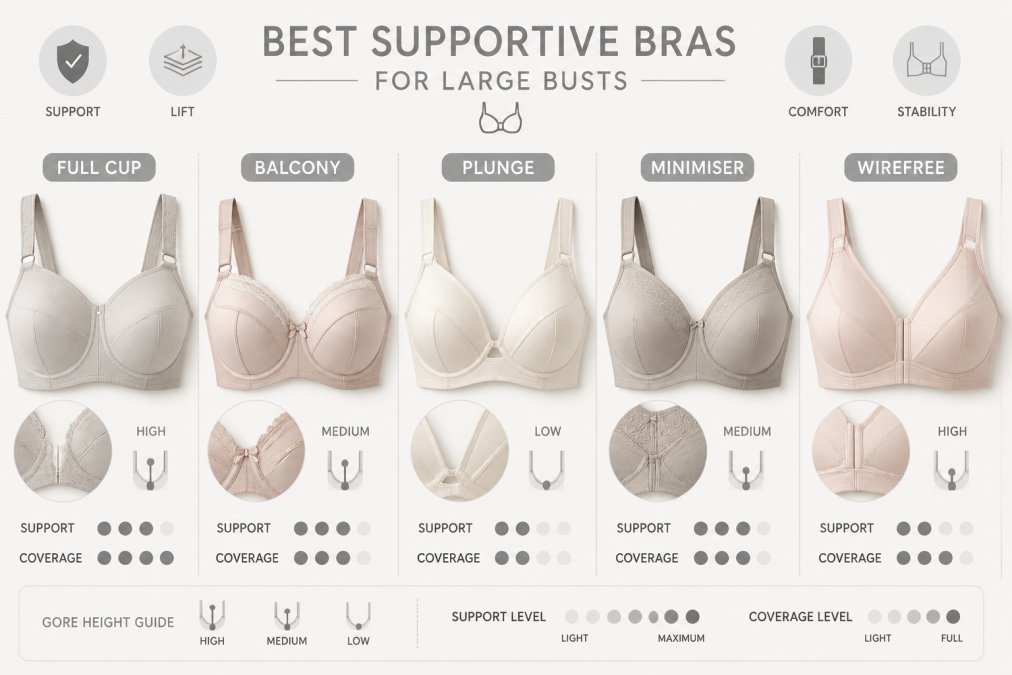
| Bra | Best For | Cup Range | Key Feature |
|---|---|---|---|
| Panache Envy Full Cup | Everyday lift and separation | D-K | Four-part seamed cups |
| Curvy Kate WonderFully Full Cup | Side support and centring | D-K | Side support panels |
| Fantasie Fusion Lace Plunge | Plunge necklines | D-H | Wide-set underwires |
| John Lewis Sofia T-Shirt | Under close-fitting tops | D-G | Seam-free moulded cups |
| Elomi Energise Sports | High-impact activity | D-KK | Four-part encapsulated cups |
| Wacoal Back Appeal | Luxury everyday smoothing | B-FF | Smooth back design |
Best Full Cup: Panache Envy Full Cup Bra
The Panache Envy is the benchmark for full cup supportive bras. Its four-part seamed cup construction provides lift and projection that moulded cups cannot replicate at larger sizes. The strong underband is the standout feature, and Panache is consistently reliable for accurate sizing. Available from D to K cup.
Pros: Exceptional lift and separation; renowned for sizing accuracy; stylish for daily wear. Cons: Lace detailing may show under fine fabrics; higher price point than mass-market alternatives.
Best for Side Support: Curvy Kate WonderFully Full Cup Side Support Bra
The Curvy Kate WonderFully uses three-part cups and dedicated side support panels to prevent lateral spillage and keep breast tissue centred throughout the day. Wide, adjustable straps reduce shoulder strain, and the bra is available from D to K cup.
Pros: Excellent containment; creates a lifted, centred shape; comfortable for long wear. Cons: Lace trims may be visible under close-fitting tops; band firmness takes adjustment.
Best for Plunge Necklines: Fantasie Fusion Lace Padded Plunge Bra
Most plunge bras sacrifice support for style. The Fantasie Fusion manages both by using wide-set underwires that sit entirely on the ribcage while padded cups provide shape and containment despite the lower centre front. For larger busts, the key is wire placement: Fantasie's wide-set design avoids wires pressing on breast tissue at the inner edge.
Pros: Genuinely comfortable; contained feeling despite the low cut; thoughtful wire placement. Cons: Less coverage than a full cup; not suited to those prioritising maximum encapsulation.
Best T-Shirt Bra: John Lewis Sofia Smooth Underwired T-Shirt Bra
The Sofia is built for the everyday invisibility that fitted tops demand. Moulded, seam-free cups with bonded edges disappear under fabric entirely, while flexible underwiring moves with the body rather than digging in during seated wear.
Pros: Completely invisible under clothing; soft fabric; flexible wire suits varied postures. Cons: Can feel warm in summer; hand-wash only.
Best Sports Bra: Elomi Energise High Impact Underwire Sports Bra
High-impact exercise without proper support damages the Cooper's ligaments that give the breast its shape over time, according to research from the University of Portsmouth's Breast Health Research Group. For larger busts, a standard sports bra without underwire rarely provides sufficient support. The Elomi Energise uses four-part encapsulated cups, each providing individual support rather than the compression approach that fails at D cup and above.
The J-hook converts the bra to a racerback style for activities where standard straps move around. Sturdy, adjustable straps and a firm band complete a design that genuinely reduces bounce during running, HIIT, or cycling. Available from D to KK cup.
Pros: True high-impact support; effective bounce reduction; convertible straps are practical. Cons: Seaming visible through fitted activewear; international sizing can be confusing on some retail sites.
Best Luxury Everyday: Wacoal Back Appeal Classic Underwire Bra
Wacoal's Back Appeal addresses the smoothing problem that many supportive bras ignore. The back design minimises bra lines under clothing, while underwired cups provide reliable lift and shaping. The craftsmanship and fabric quality are noticeably higher than mid-market alternatives. Available up to FF cup.
Pros: Smooth back finish; high-quality materials; elegant enough to feel like a treat. Cons: Size range caps at FF; delicate fabrics require careful laundering.
Best Non-Wired Bras for Large Busts
Wire-free does not mean unsupportive, but it does mean the construction must work harder to compensate for the absence of an underwire. The best non-wired bras use wide bands, structured cup seaming, and wide straps to distribute weight without a wire.
The Royce Grace 513 Cotton Rich Non-Wired Bra is the standout option in this category. Cotton-rich fabric makes it genuinely breathable, the full cup design encapsulates the bust completely, and wide straps reduce shoulder strain. For women who find underwires uncomfortable, this is the construction to look for.
Post-Surgery and Sensitive Skin Considerations
Post-surgery bras have specific requirements. After mastectomy, lumpectomy, or reconstructive surgery, seam placement matters because seams against healing tissue cause irritation; wire-free designs are typically recommended for a significant period post-operatively; and breast forms require specific pocket designs to stay secure.
Cotton and cotton-rich fabrics are most appropriate for sensitive or healing skin. Royce and similar specialist brands design specifically for post-surgery wear, with soft, tagless construction and adjustable features that accommodate swelling and asymmetry during recovery. A specialist fitting service is genuinely important for post-surgery bra fitting, as the variables involved mean that online sizing guides have real limitations.
Wired vs. Wire-Free: Which Gives Fuller Busts Better Support?
For most fuller busts, underwired bras provide better support than wire-free alternatives. The underwire sits in the inframammary fold and acts as a rigid anchor for the cup, preventing the base of the bra from lifting away from the body under weight.
The correct answer depends on fit. A well-fitted wire-free bra outperforms a poorly fitted underwired one every time. Wire-free bras are genuinely the better choice during pregnancy and nursing, when breast tissue changes rapidly; during post-surgery recovery, when wires are contraindicated; and for women whose breast root shape or ribcage structure makes underwires consistently uncomfortable. For everyday wear, guidance from the British School of Osteopathy on posture and bra support aligns with what specialist fitters observe: adequate support reduces the postural compensation patterns that cause neck and upper back pain in women with larger busts.
Why a Professional Bra Fitting Changes Everything
A professional bra fitting removes the guesswork that makes self-sizing unreliable. A trained fitter can assess breast shape, root width, tissue firmness, and torso proportions in ways that no measuring tape can replicate, then match those characteristics to specific styles and constructions.
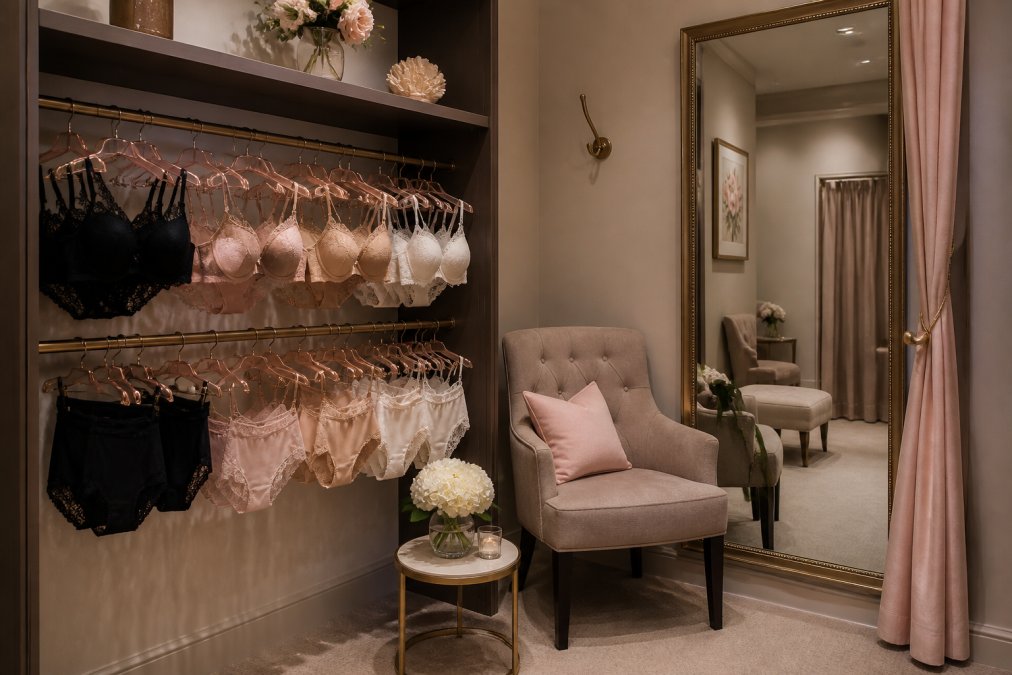
Many women discover they have been wearing the wrong size for years, often in a band that is too large and a cup that is too small. The correction can feel dramatic: a smaller band and larger cup is the most common adjustment, and the difference in support and comfort is immediate. According to Which? consumer guidance on bra fitting, professional fittings consistently result in women moving to a different size than they had been wearing, with the majority reporting improved comfort and support afterwards.
Conclusion
Finding the right supportive bras for large busts comes down to understanding your own fit requirements, knowing which structural features actually do the work, and being willing to try styles that might look different from what you are used to.
Amelie Devizes offers expert, personalised bra fitting appointments in a warm and inclusive boutique environment, including specialist fittings for post-surgery, bridal, and first-time fitting needs. Our curated selection focuses on brands that genuinely deliver support at fuller cup sizes. Visit the Amelie Devizes website to explore our lingerie collection and book your fitting.
Frequently Asked Questions
What type of bra is best for supporting heavy breasts?
For heavy breasts, a full cup bra with underwiring, seamed cups, a firm underband, and wide cushioned straps distributes weight most effectively. The band should do around 80% of the lifting work, so a snug, well-fitted band size is essential. Wide side support panels prevent spillage and keep breast tissue centred. Brands such as Panache, Curvy Kate, and Elomi specialise in these features across D to K+ cup sizes. A professional bra fitting will confirm the correct band and cup combination for your shape.
Are non-wired bras effective for large busts?
Non-wired bras can offer genuine support for larger busts when they are correctly sized and well-constructed. Look for a firm, wide underband, full cup coverage, wide adjustable straps, and a structured cup with shape retention. Wire-free options such as the Royce Grace are particularly suited to post-surgery wear, sensitive skin, or everyday comfort. The key difference is that without underwire, the band must fit even more precisely to compensate, so getting your measurements right is especially important.
How should a supportive bra fit for a large bust?
A correctly fitting bra for a fuller bust should have a band that sits level all the way round and does not ride up at the back. The gore (the centre panel) should tack flat against the sternum. Cups should contain all breast tissue without spillage or gaping. Adjustable straps should sit comfortably on the shoulders without digging in or leaving red marks. The underwire, if present, should follow the natural crease of the breast and sit flat against the ribcage, not on breast tissue.
What features should I look for in a supportive bra for a fuller cup?
Prioritise a firm underband in the correct size, seamed or multi-part cups for lift and projection, wide cushioned adjustable straps to prevent shoulder indentation, and a gore that tacks flat. Side support panels help contain breast tissue and prevent spillage. Breathable fabric such as cotton-rich or moisture-wicking material improves all-day comfort. Hook and eye closure with multiple columns gives a more precise fit. For sports, look for encapsulated cups that support each breast individually to reduce bounce.
How often should you replace your supportive bras?
Most bras for larger busts should be replaced every six to twelve months with regular wear, or sooner if the band has lost its elasticity, the underwire is protruding, or the hook and eye closure no longer holds firmly. Rotating between two or three bras and washing them on a gentle cycle in a lingerie bag extends their lifespan. If you notice the band riding up, straps slipping constantly, or cups losing their shape retention, it is time for a new fitting and a replacement.
This article was written using GrandRanker