

How to Choose the Right Post Surgery Bra: 2026 Fit Guide
Table of Contents
- Why the Right Post Surgery Bra Matters for Healing
- Features of Post-Operative Bras That Support Recovery
- How Long to Wear a Compression Bra After Surgery
- Mastectomy Bra Fitting Guide: Getting the Size Right
- Choosing Based on Surgery Type: Mastectomy vs Augmentation
- Caring for Your Post Surgery Bra: Washing and Accessories
- Conclusion
- Frequently Asked Questions
Last Updated: September 10, 2026
Why the Right Post Surgery Bra Matters for Healing
Choosing the right post surgery bra is one of the most practical decisions you will make during recovery. A well-fitted compression garment supports fragile tissue, reduces swelling, and protects incisions.
The difference between a bra that works and one that sits in a drawer comes down to fabric, closure type, compression level, and fit.
Get those right and recovery feels calmer. Get them wrong and you will know within an hour.
Post-surgical edema, the fluid build-up that follows most breast procedures, needs consistent, gentle pressure to disperse. NHS guidance on breast surgery recovery notes that swelling can persist for several weeks after surgery, which is why a compression bra is usually worn continuously at first. A bra that digs in or rides up will not apply even pressure, and uneven pressure is worse than none at all.
Features of Post-Operative Bras That Support Recovery
Post-operative bras share design features that separate them from everyday lingerie. Look for soft-touch materials, non-wired cups, and closures you can manage one-handed in the first weeks.
| Feature | Why It Matters | What to Look For |
|---|---|---|
| Front-fastening | Easier to put on when arm movement is limited | Hook-and-eye closure at the front |
| Non-wired cups | Avoids pressure on the surgical site | Soft cups or moulded microfibre |
| Seamless construction | Reduces friction and irritation | Bonded edges, no raised seams |
| Breathable fabric | Keeps skin cool and dry | High cotton content or moisture-wicking microfibre |
| Adjustable straps | Adapts to changing swelling | Wide, padded, fully adjustable |
| Wide underband | Distributes pressure evenly | No digging, no rolling |
Front-Fastening and Hook-and-Eye Closures
A front-fastening bra is the single most useful feature in the first fortnight after surgery, when reaching behind your back is difficult or impossible.
Hook-and-eye closures let you adjust the band as swelling rises and falls; most post-surgical bras offer several rows of hooks. A front-opening, non-wired triangle bra does the same job with a gentler profile, suiting lighter compression needs.

Non-Wired, Seamless, and Breathable Construction
Wire-free construction is non-negotiable after breast surgery. Underwires concentrate pressure along the inframammary fold, where many incisions sit, and can rub against forming scar tissue.
Seamless bras reduce friction further: bonded or moulded cups sit flat against the skin, and soft-touch microfibre moves with you. Breathability matters too, so prioritise cotton-rich or moisture-wicking fabrics.
How Long to Wear a Compression Bra After Surgery
Most surgeons recommend wearing a compression bra continuously for the first two to six weeks, then during the day for several more (the NHS). The exact timeline depends on your procedure and your surgeon's instructions. A common approach is 24 hours a day for the first fortnight, removing the bra only to wash, followed by daytime wear for a further four to six weeks; some patients continue overnight wear longer if swelling is slow to settle.
Why the Timeline Varies So Much
Compression applies external counter-pressure while the body reabsorbs post-surgical fluid, and that process is not linear. Swelling typically peaks in the first 48 to 72 hours, then reduces over weeks rather than days (peer-reviewed research). A bra that fits on day one may feel tight by day four and loose by week three, so the schedule is usually adjusted rather than fixed.
Procedure type is the biggest variable. More extensive surgery, or surgery involving the axilla (the armpit area), tends to need longer continuous compression. Reconstruction with implants or flaps often needs firmer, longer compression than a straightforward augmentation.
A Practical Way to Judge When to Reduce Wear
Rather than counting weeks in isolation, most practitioners suggest reducing compression gradually and watching how the tissue responds:
- Weeks 1-2: Continuous wear, removing the bra only to wash or shower.
- Weeks 3-4: Continue overnight wear, but you may be able to switch to a lighter compression bra during the day if your surgeon agrees.
- Weeks 5-8: Daytime wear only, moving towards a soft, non-wired support bra.
- Beyond 8 weeks: Transition to a regular soft bra, keeping compression for exercise or long days on your feet if swelling returns.
If swelling increases after you reduce wear, step back up rather than push through, and ask your surgical team whether it needs review.
Signs You Should Not Reduce Compression Yet
Some indicators suggest the tissue still needs support:
- Visible or palpable swelling that has not reduced over several days.
- A feeling of heaviness or a dragging sensation in the breast.
- Seroma (a pocket of fluid) that has been drained or is being monitored.
- Discomfort when you move your arm or reach overhead.
None are emergencies on their own, but they are reasons to keep wearing the bra as advised and check in with your specialist nurse before loosening the schedule.
What About Sleeping?
Overnight wear is where many people struggle, because a bra that feels fine standing up can dig in when you lie down. A front-fastening bra with a wide, padded underband and adjustable straps is easier to tolerate overnight. If the band rolls or rides up in bed, a bra extender can add a row of hooks for the first few nights without compromising fit.
When to Ask Your Surgeon
Ask your surgical team specifically:
- How many weeks of continuous wear they want for your procedure.
- Whether you should wear the bra at night after the first fortnight.
- Whether you can switch to a lighter compression bra, and when.
- What signs would mean you should come back in for review.
Follow your surgical team's guidance over any general rule, and ask your surgeon or specialist nurse rather than guessing.
Mastectomy Bra Fitting Guide: Getting the Size Right
Getting the size right is the difference between a bra that supports healing and one that causes new problems. A mastectomy bra fitting guide starts with two measurements: band and cup size.
Measure your band size around your ribcage, directly under the bust, keeping the tape snug but not tight, then around the fullest part of your bust; the difference gives your cup size. After surgery, measure again once initial swelling has settled, because your size will change.
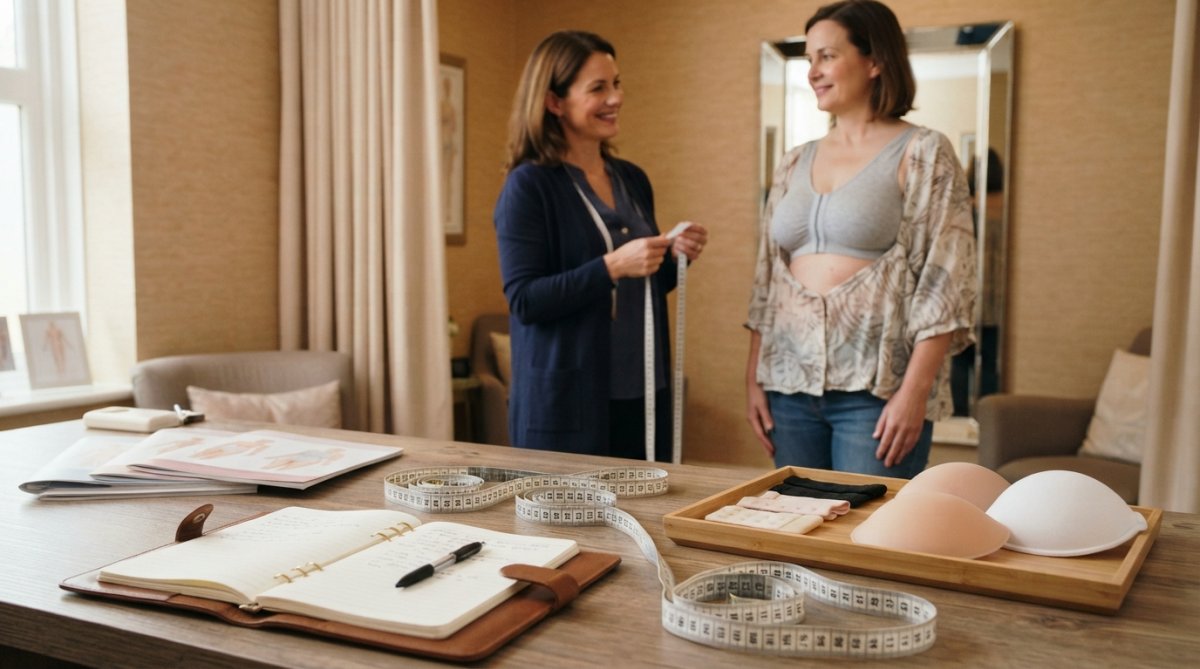
Measuring Band Size and Cup Size at Home
Take your band measurement first, exhaling fully so the tape sits against your ribcage. Round to the nearest even number for comfort.
For cup size, measure loosely across the fullest point without compressing tissue. After a unilateral mastectomy, measure each side separately and fit to the larger side, then use a breast form or soft filler to balance the other. Breast forms from Anita and Boost sit inside a mastectomy bra pocket, keeping the form stable and the silhouette even.
If you would rather not measure alone, a professional fitting takes the guesswork out. Amelie Devizes offers personalised post-surgery fitting in a calm, private setting.
Choosing Based on Surgery Type: Mastectomy vs Augmentation
Surgery type changes what you need from a bra. Mastectomy and reconstruction call for pocketed designs and breast form compatibility; augmentation usually calls for lighter compression and a softer cup.
After a mastectomy, a pocketed bra holds a breast form securely. After augmentation, the priority is gentle compression that supports the implants without pressing on incision sites. Lumpectomy patients sit in between: light compression, soft seams, and a cup that does not rub the treated area. exercising after surgery.
| Surgery Type | Compression Level | Key Feature | When to Wear |
|---|---|---|---|
| Mastectomy | Moderate to firm | Pocketed cups for breast forms | 24/7 initially, then daytime |
| Lumpectomy | Light to moderate | Seamless, non-wired cups | Day and night at first |
| Augmentation | Light | Soft, stretchy compression | As advised by surgeon |
| Reconstruction | Moderate | Front-fastening, adjustable band | Continuous at first |
Why the Differences Matter
Each procedure needs a different approach because of what happens under the skin. A mastectomy removes breast tissue and often some lymph nodes, changing the shape of the chest wall and leaving a flatter or uneven surface. A pocketed bra holds a breast form in a fixed position, distributing weight evenly rather than pulling on one side.
Augmentation places an implant behind or in front of the chest muscle. The implant is stable, but the surrounding tissue needs gentle, even pressure to settle: too much compression can press on the incision or distort implant position, too little lets fluid collect. That is why augmentation bras are lighter and stretchier than mastectomy bras.
Reconstruction sits between the two: flap reconstruction needs support without restriction, while implant-based reconstruction is closer to augmentation but with a longer compression timeline.
Fitting Trade-Offs to Expect
- Mastectomy: Fit to the larger side if you have had a unilateral procedure, then use a breast form or soft filler to balance the other side. Pocketed bras keep the form stable, but they can feel bulkier under close-fitting clothes. A lighter, non-pocketed bra with a separate form holder is an option for evenings out.
- Lumpectomy: The treated area may be tender for weeks, so a seamless cup with no raised seams is more comfortable than a moulded cup with a defined edge. You may not need a pocket, but a soft bra liner can reduce rubbing.
- Augmentation: Avoid bras with a defined underwire channel, even if the wire is removed, because the channel itself can press on the incision. A soft, stretchy crop-top style often works better than a structured bra in the first fortnight.
- Reconstruction: Front-fastening is almost essential in the early weeks, and an adjustable band lets you manage swelling without buying a new bra.
Accessories That Make a Difference
Bra extenders make a real difference: as swelling fluctuates, an extender adds a row or two of hooks without needing a new bra, far cheaper than replacing your set mid-recovery. Soft bra liners and cotton pads also reduce rubbing against sensitive scar tissue.
If you use a breast form, check that the pocket depth suits it. A form that sits too high or too low will not look natural and can cause discomfort at the edges. Most forms come with a guide, but a fitting appointment is the surest way to get it right.
Caring for Your Post Surgery Bra
Medical-grade fabrics need gentler care than everyday lingerie. Hand wash in cool water with a mild detergent, then air dry flat away from direct heat.
Heat breaks down the elastane that gives a compression bra its stretch, so never tumble dry and never iron. A mesh laundry bag protects hook-and-eye closures if you prefer a machine wash on a delicate cycle. Buy two or three bras so one is always clean while another dries.
If you have been prescribed a specific compression garment, follow the manufacturer's care label rather than a general rule.
The Sloggi ZERO Feel Top (£30.00) works well for lighter compression needs, with a seamless, wireless design that feels like a second skin. For firmer support with a front closure, the Lise Charmel Désir Et Volupté front-opening non-wired triangle bra (£152.00) combines post-surgical function with something genuinely beautiful to wear.

Caring for Your Post Surgery Bra: Washing and Accessories
Conclusion
Recovery is demanding enough without wrestling with a bra that does not fit, and the right garment changes how the first weeks feel. Amelie Devizes offers expert post-surgery bra fitting, a curated range of non-wired and front-fastening designs, and breast forms and accessories chosen with care. Our fitting service is built around personalised support. Shop all products at Amelie Devizes and find the fit that helps you heal in comfort.
Frequently Asked Questions
What is the best bra to wear after breast surgery?
The best post surgery bra is front-fastening with adjustable straps, a soft hook-and-eye closure, and no underwire. Cotton-rich, breathable fabric reduces friction around the surgical site, while gentle compression supports tissue and helps manage swelling. Look for seamless cups that sit flat against the skin and a band that stays put without digging in. A professional fitting ensures the band and cup sizes work together to protect incisions during the healing process.
How long do I need to wear a compression bra after surgery?
Most surgeons recommend wearing a compression bra 24 hours a day for the first two to six weeks after surgery, then during the day for several more weeks. The exact timeline depends on your procedure, swelling levels, and your surgeon's advice. Remove it only for washing or as directed. If you notice increased swelling or discomfort when you stop, go back to wearing it and check with your surgical team before changing your routine.
Are post-surgery bras meant to be tight?
They should feel snug but never painful. A well-fitted post surgery bra applies even, gentle compression across the chest to reduce swelling and support healing tissue. If you can slide two fingers under the band, the fit is about right. Red marks, numbness, or rib pain mean the bra is too tight. Adjustable straps and hook-and-eye closures let you fine-tune the fit as swelling changes from week to week.
Do I need a professional fitting after breast surgery?
Yes, a professional fitting makes a real difference after surgery. Your size often changes due to swelling, tissue removal, or reconstruction, so the bra you wore before may not fit correctly. A trained fitter can measure your band and cup size, check for pressure points around the surgical site, and recommend styles suited to your recovery phase.