

Fitting Service vs Boutique Experience: What to Choose
Table of Contents
- Fitting Service vs Boutique Experience: The Key Differences
- What to Expect at a Bra Fitting Appointment
- Why the Right Fit Matters More Than the Label
- Bra Fitting After Pregnancy: When Your Body Changes
- A Post-Surgery Bra Fitting Guide for Comfort and Support
- How to Prepare for Your Boutique Fitting Session
- Conclusion: Invest in a Fitting Service That Feels Personal
- Frequently Asked Questions
Last Updated: September 5, 2026
Fitting Service vs Boutique Experience: The Key Differences
A fitting service vs boutique fitting experience comparison comes down to one central question: do you want a transaction, or do you want to feel truly seen? Many women have stood in a high street changing room, told they're a size they've never worn, and left feeling worse than when they arrived. At Amelie Devizes, we believe a professional bra fitting should never feel clinical or rushed. The difference between a standard fitting service and a boutique experience shapes everything from your comfort to your long-term breast health.
To understand the choice, it helps to move beyond simple labels and look at the three distinct service models you will actually encounter on the UK high street and beyond.
The Three Service Models Explained
1. The High-Street Retail Fitting
This is the most accessible option, offered by national chains and department stores. It is typically free, requires no appointment, and takes between five and ten minutes. The fitter is trained to use a measuring tape and a size chart, and the fitting is constrained by the stock on the floor. If the store's range starts at a 32 band or ends at a DD cup, your fitting will likely conclude within that matrix, regardless of your actual needs. The primary goal is often to complete a sale efficiently.
2. The Specialist Lingerie Boutique
This is the model we operate at Amelie Devizes. A specialist boutique fitting is an appointment-based service, typically lasting 30 to 45 minutes, conducted in a private fitting room. The fitter is not just trained in measurement but in breast shape analysis, posture, and the biomechanics of support. The fitting is not constrained by stock; instead, a wide range of sizes and styles is available to match your unique frame. The goal is long-term fit and comfort, not a quick transaction.
3. The Independent Bra Fitter (Home or Mobile Service)
A growing niche in the UK is the independent fitter who travels to your home. This offers the ultimate in privacy and convenience, particularly for those with mobility issues or post-surgical needs. The trade-off is that their stock is limited to what they can carry, and their pricing can be higher to account for travel time. However, the consistency of seeing the same expert each time is a significant advantage.
A Direct Comparison: Boutique vs. High-Street vs. Specialist
To make the choice clearer, here is a side-by-side comparison of what you can expect from each service type. This framework is rarely laid out so plainly, yet it is the most effective way to match your needs to the right service.
| Feature | High-Street Retail | Specialist Boutique | Independent Fitter |
|---|---|---|---|
| Appointment Length | 5-10 minutes | 30-45 minutes | 45-60 minutes |
| Environment | Open-plan or shared cubicle | Private, unhurried room | Your own home |
| Fitter Expertise | Basic size-chart training | Advanced shape & posture analysis | Advanced, often specialised |
| Size Range Available | Limited to store stock | Extended (28-40+ bands, AA-K cups) | Limited to carried stock |
| Follow-up Support | None | Yes, often informal | Yes, often structured |
| Cost | Free (with purchase) | Free or included in purchase price | Often a fee, credited toward purchase |
| Suitable For | Quick updates, known size | First fittings, shape changes, post-natal | Post-surgery, mobility issues |
This comparison highlights the core difference: a high-street service fits you to its stock, while a boutique service fits the stock to you. The latter requires a deeper investment in training and time, which is why the experience feels fundamentally different.
The Emotional Dimension Often Overlooked
Beyond the technical metrics, there is a psychological factor that separates these services. A high-street fitting can feel performative, conducted in a semi-public space where you might feel rushed or judged. A boutique experience is designed to be non-judgmental. The private room, the unhurried pace, and the fitter's focus on your comfort create a space where you can be honest about your body without embarrassment. This psychological safety is not a luxury; it is a prerequisite for a fitter to do their job well, as you are more likely to disclose discomfort or specific concerns when you feel at ease.
This combination of technical depth and emotional safety is what defines a true boutique experience. It is not about a fancy interior; it is about a service model designed around your body, not a sales target.
What to Expect at a Bra Fitting Appointment
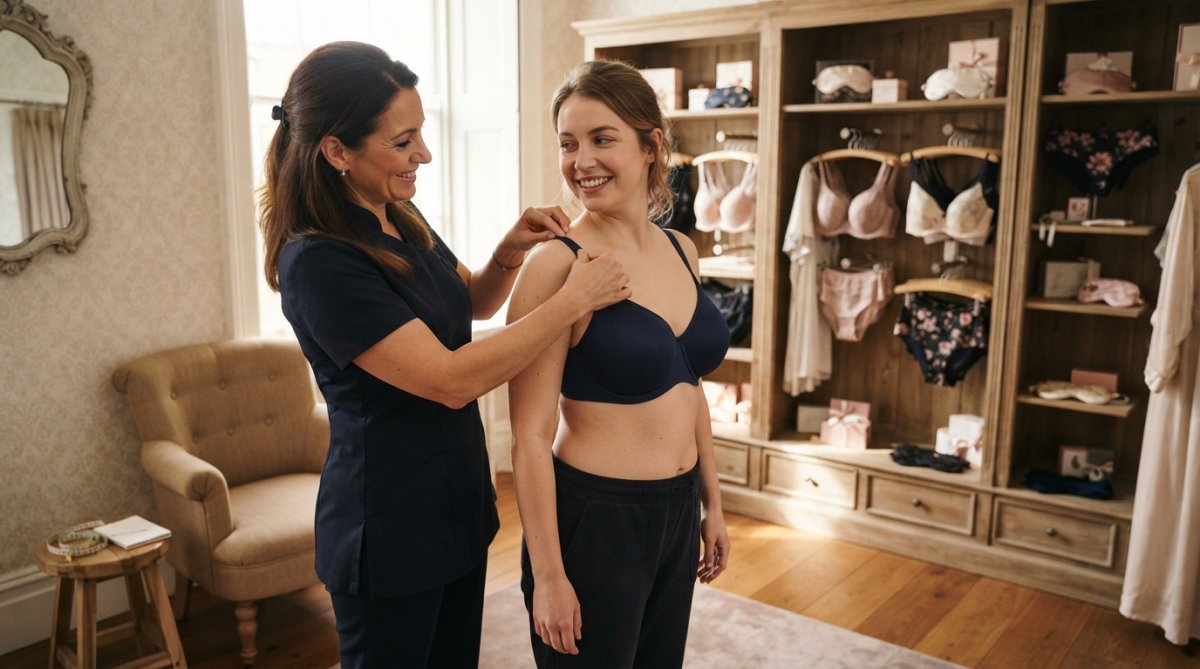
A professional bra fitting appointment typically lasts between 30 and 45 minutes, far longer than the five-minute check you might receive elsewhere. You will be measured, but more importantly, you will be listened to. The fitter will ask about any discomfort, how your current bras feel at the end of the day, and what you need from your lingerie, whether that is support for running, seamless options for work, or something beautiful for a special occasion.
You will try on several styles because size is only the starting point. Different cuts suit different breast shapes, and a skilled fitter will explain why a balconette sits differently from a full cup on your frame. This is the fitting accuracy that makes the difference between a bra you tolerate and one you forget you are wearing.
Why the Right Fit Matters More Than the Label
The number on the label matters far less than how the bra performs on your body. Many women discover they have been wearing the wrong size for years, yet the right fit transforms more than just appearance. A supportive bra distributes the weight of your breasts across your ribcage rather than pulling on your shoulders, which directly affects back and neck comfort.
Consistency in measurements is another reason the boutique approach wins. When you return to the same fitter who remembers your shape and preferences, the customer journey becomes a relationship rather than a repeated explanation. Your fitter notices subtle changes you might miss and can recommend adjustments before discomfort becomes a problem.
The Technical Mechanics of a Good Fit
The difference between a bra that fits and one that merely seems okay is measurable. A correct fit means your band is level across your back and sits firmly on the widest part of your ribcage, providing approximately 80% of the bra's support (peer-reviewed research). The underwire should fully encase your breast tissue, lying flat against your sternum in the centre and not digging into your underarm. The straps should be adjusted to carry only about 20% of the weight, meaning they should not be digging into your shoulders to compensate for a loose band.
A common pattern is that women wear a band size too large and a cup size too small to compensate. This creates a cascade of problems: the band rides up at the back, the straps dig in, and the centre gore floats away from the chest wall. A professional fitter checks for these specific markers, not just the tape measure reading.
When to Return: The Maintenance Schedule No One Tells You About
Most guides stop at the fitting itself, but the real value lies in what happens afterwards. Your body is not static, and neither is your bra. Here is a practical timeline for when to seek a re-evaluation:
- Every 6 Months: A routine check-in. Your weight can fluctuate by a few pounds without you noticing, and this directly affects band fit. A six-monthly measurement catches shifts in band fit and cup volume that you simply cannot see yourself.
- After Significant Weight Change: Any gain or loss of more than one stone (approximately 6-7 kg) will change your bra size (peer-reviewed research). Do not wait for discomfort; book a fitting as soon as your weight has stabilised.
- After Pregnancy or Surgery: Your body continues to change for months after these events. A fitting at three months postpartum is a starting point, but many women need another fitting at six months as their milk supply regulates and their ribcage settles.
- When Your Bra's Elastic Wears Out: A well-made bra lasts between 6 and 9 months of regular wear before the elastic begins to fatigue (peer-reviewed research). If you notice the band riding up or the straps needing constant adjustment, the bra is telling you it is time for a replacement and a re-fit.
The Long-Term Value of a Relationship with a Fitter
This is where the boutique model differs fundamentally from a transactional service. When you see the same fitter regularly, they build a picture of your shape over time. They know that your left breast is slightly larger than your right, that you prefer a lower gore for your sternum sensitivity, and that your size shifts a little during your menstrual cycle. This institutional knowledge means each subsequent fitting is faster and more accurate, and you are less likely to experience the 'start from scratch' frustration of explaining your history to a new person each time.
A good boutique will also keep a record of your fittings and purchases. When you return, they can pull up your history and see what you bought last year and how it has performed. This level of continuity is impossible to replicate on the high street and is the true marker of a service that values your long-term comfort over a single sale.
Bra Fitting After Pregnancy: When Your Body Changes
Bra fitting after pregnancy is one of the most overlooked transitions in women's health. Your breasts change dramatically during pregnancy and again when your milk supply regulates. The bra that fit you at eight months pregnant will not serve you at three months postpartum, and wearing the wrong size during this period can contribute to blocked ducts and significant discomfort.
A fitting at this stage should address nursing access, softness of fabric against sensitive skin, and support that adapts as your body continues to change. Many mothers find their ribcage has expanded permanently during pregnancy, meaning their pre-pregnancy band size no longer applies. A professional fitting after your milk supply settles, usually around three months postpartum, gives you a foundation that supports you through the demands of early motherhood.
A Post-Surgery Bra Fitting Guide for Comfort and Support
A post-surgery bra fitting guide must begin with gentleness. Whether you are recovering from breast surgery, reconstruction, or living with breast cancer, your needs are both physical and emotional. The right post-surgery bra provides security without pressure, and soft fabrics that do not irritate scars or sensitive skin.
Specialist guidance in this area is essential because standard retail bras are rarely suitable. Post-surgery options, including breast forms and accessories, require careful consideration of weight, placement, and pocket construction. A fitter experienced in this area understands the importance of dignity, patience, and technical knowledge. They will help you find pieces that offer genuine support while allowing you to feel like yourself again.
How to Prepare for Your Boutique Fitting Session
Preparing for your fitting session is simple, and there is no need to feel nervous. Wear a bra you currently use, even if it is uncomfortable, because it gives the fitter valuable information about what is not working. If you are coming after surgery or pregnancy, bring details of your procedure or your nursing routine so the fitter can recommend appropriate options.
Allow yourself time, and come with an open mind about your size. The number may surprise you, but the goal is how the bra feels, not the label. If you have specific needs, such as bridal lingerie that must work under a particular dress, mention this when booking so the appointment can be tailored to your requirements.
Conclusion: Invest in a Fitting Service That Feels Personal
The choice between a fitting service vs boutique fitting experience ultimately reflects how you want to feel about your body. A boutique experience offers the psychological comfort of being seen and understood, alongside the technical expertise that delivers genuine support. Whether you are navigating post-pregnancy changes, recovering from surgery, or simply tired of bras that dig and pinch, a personalised consultation changes what you expect from your lingerie.
At Amelie Devizes, our expert bra fitting services are designed for every woman, from brides needing a perfect fit under their gown to those seeking post-surgery comfort and confidence. Our warm, inclusive environment ensures you feel at ease from the moment you arrive. Explore our lingerie collection and fitting appointments to experience the difference for yourself.
Frequently Asked Questions
What is the difference between a standard bra fitting and a boutique experience?
A standard fitting service, often in a high-street store, focuses on a quick measurement to match you with the styles that store carries. A boutique fitting experience goes further. The fitter considers your body shape, your lifestyle, and any specific needs you have, such as post-surgery or maternity support. The appointment is private, unhurried, and tailored to you. You receive specialist guidance rather than a generic size check, which means the result is a bra that fits correctly and feels comfortable.
Are boutique bra fitting services more expensive than high-street stores?
The fitting itself is often complimentary in a boutique, just as it is on the high street. The difference lies in the products. Boutique bras typically come from specialist brands that prioritise fabric quality, construction, and support. They cost more than mass-market options, but they last longer and provide better fit accuracy. You are paying for expert consultation, a wider range of sizes, and a personalised assessment that helps avoid the discomfort of an ill-fitting bra.
How long does a professional bra fitting usually take?
A professional bra fitting in a boutique setting usually takes between 30 and 45 minutes. This allows time for a thorough measurement, trying on several styles, and discussing your needs. The fitter will check the band, the cup, and the straps, and will explain why certain styles work better for your shape. A high-street fitting can be quicker, but the extra appointment duration in a boutique ensures the tailored solution is right for you.
Why is a personalised fitting important after pregnancy or surgery?
Your body changes significantly after pregnancy and surgery, so your bra size and shape needs shift. A personalised fitting service recognises that standard sizing may no longer apply. After pregnancy, your breast tissue and support needs differ, especially if you are nursing. After surgery, you need gentle support that protects healing tissue and accommodates prosthetics. A specialist fitter provides professional measurement and expert consultation to find styles that offer comfort, support, and confidence during these transitions.
Finding the right bra should never feel like a compromise between comfort and beauty. Amelie Devizes brings together expert, personalised fitting with high-quality lingerie that makes you feel confident and empowered. Book your private appointment with us and discover a fitting experience that honours your body and your story.