
Comfortable Maternity Bras for Nursing: 2026 Guide
Table of Contents
- What Makes Comfortable Maternity Bras for Nursing Worth the Investment
- When to Buy Nursing Bras: A Postpartum Body Changes Timeline
- How to Measure Bra Size During Pregnancy (Step-by-Step)
-
Top Comfortable Maternity Bras for Nursing: Our Picks Compared
- Bravado Designs Body Silk Seamless Nursing Bra
- Royce Blossom Nursing Bra
- Seraphine Bamboo Soft Seamless Maternity & Nursing Bra 2-Pack
- Emma-Jane 365 Non-Wired Nursing Bra
- Medela Comfy Maternity & Nursing Bra
- Cake Maternity Waffles 3D Spacer Nursing Bra
- Boob Design Fast Food Soft Sports Nursing Bra
- Hotmilk Lunar Eclipse Wire-Free Nursing Bra
- M&S Flexifit Non-Wired Full Cup Nursing Bra
- Best Nursing Bras for Large Breasts: D Cup and Above
- Eco-Friendly and Sustainable Fabric Choices
- Bra-Related Health Issues to Watch For During Nursing
- Which Nursing Bra Should You Choose?
Last Updated: August 12, 2026
Finding comfortable maternity bras for nursing is one of those decisions that feels small until you're three weeks postpartum, engorged, and struggling with a fiddly clip at 3am. At Amelie Devizes, we know how much the right bra matters during this season of your life, which is why we've pulled together this honest guide to help you choose well.
Quick Picks:
- Best overall: Hotmilk Lunar Eclipse Wire-Free Nursing Bra, outstanding support for D+ cups with magnetic clips
- Best value: Emma-Jane 365 Non-Wired Nursing Bra, affordable, versatile, day-to-night wear
- Best eco choice: Seraphine Bamboo Soft Seamless Maternity & Nursing Bra 2-Pack, hypoallergenic bamboo viscose
- Best for active mothers: Boob Design Fast Food Soft Sports Nursing Bra, sustainable, fast-drying, sports-ready
- Best for shape under clothing: Cake Maternity Waffles 3D Spacer Nursing Bra, smooth silhouette, flexible wire
What Makes Comfortable Maternity Bras for Nursing Worth the Investment
Maternity bras for nursing accommodate dramatic breast tissue changes, provide access for feeding without full removal, and avoid pressure on developing milk ducts, requirements mass-market bras cannot meet.
Wire-Free vs. Underwired: Which Is Right for You?
Wire-free is the safer default for most nursing mothers. Underwired bras can press against milk ducts as breast size fluctuates with engorgement, potentially increasing risk of blocked ducts and mastitis. The NHS on breastfeeding and breast care recommends avoiding tight or restrictive clothing around the breast during breastfeeding.
Wire-free does not mean unsupportive. The Hotmilk Lunar Eclipse uses four-piece cup construction and six rows of hook-and-eye closure for structured support without wire. The Cake Maternity Waffles offers a middle ground: a flexible wire that moves with the body rather than digging in.
Start wire-free, especially in the first eight weeks postpartum when size is most unpredictable.
Key Features to Look For: Clips, Fabric, and Fit
The best nursing bras share these essentials:
- Drop-down or drop-cup access: Allows one-handed feeding without removing the bra. Magnetic clips are particularly fast.
- Adjustable straps and multiple hook-and-eye rows: Your back measurement will change throughout pregnancy and postpartum. Four or more hook positions adapt with you.
- Breathable, skin-safe fabric: Cotton-lined cups, bamboo viscose, and moisture-wicking materials reduce irritation and manage leakage.
- Stretchable material in the cups: Four-way stretch fabric accommodates fluctuating breast size without creating pressure points.
- Full coverage cups: Especially important for larger busts, reducing spillage and providing better weight distribution.
A lounge or sleep bra alongside your daytime nursing bra reduces the number you need to buy overall.
When to Buy Nursing Bras: A Postpartum Body Changes Timeline
Third trimester (36 weeks+): Buy one or two nursing bras now, but size up by at least one cup. Your breasts will increase further once milk comes in, typically on days three to five after birth.
Postpartum weeks one to six: This is the most volatile period. Breast engorgement peaks in the first week and gradually settles as supply regulates. Bras with maximum adjustability are essential.
Six weeks to six months: Size tends to stabilise. This is the right moment to invest in better-quality, more structured nursing bras if you plan to continue breastfeeding.
How to Measure Bra Size During Pregnancy (Step-by-Step)
Knowing how to measure bra size during pregnancy accurately is the single most important step in finding a comfortable fit.
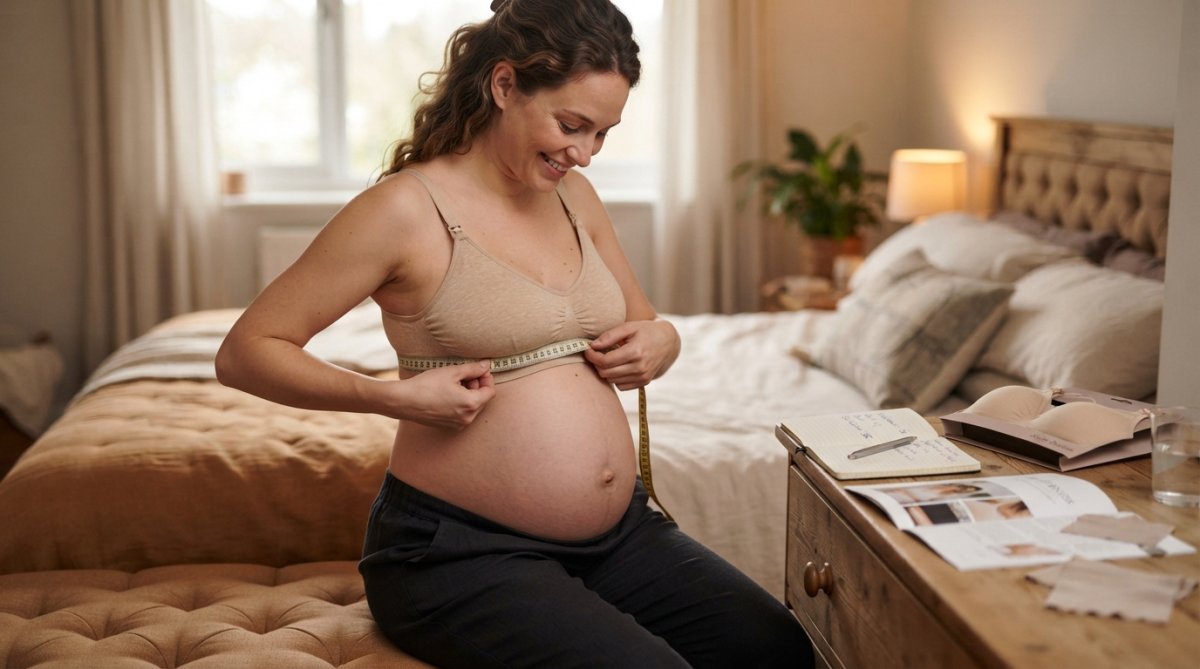
What you will need: A soft fabric measuring tape, a well-fitting non-padded bra or no bra, and a mirror.
Step 1: Measure your band size Standing upright, wrap the measuring tape firmly around your ribcage directly under your bust. The tape should be level and snug but not tight. Convert: 70cm = 32, 75cm = 34, 80cm = 36, 85cm = 38, 90cm = 40, in 5cm increments. Round up during pregnancy if your measurement falls between sizes.
Step 2: Measure your bust Wrap the tape around the fullest part of your bust, keeping it level without pulling tight.
Step 3: Calculate your cup size Subtract your band measurement from your bust measurement. Each 2.5cm difference corresponds to one cup size: 2.5cm = A, 5cm = B, 7.5cm = C, 10cm = D, 12.5cm = DD, 15cm = E.
Step 4: Allow for growth During pregnancy, add at least one cup size to your calculated measurement. In the third trimester, consider adding a further half to full cup size to account for engorgement after birth.
Step 5: Try before you commit The band should sit level and firm across your back with two fingers fitting underneath. The underwire or lower edge should sit flat against your ribcage, not on breast tissue. Straps should not dig in or slide off.
Top Comfortable Maternity Bras for Nursing: Our Picks Compared
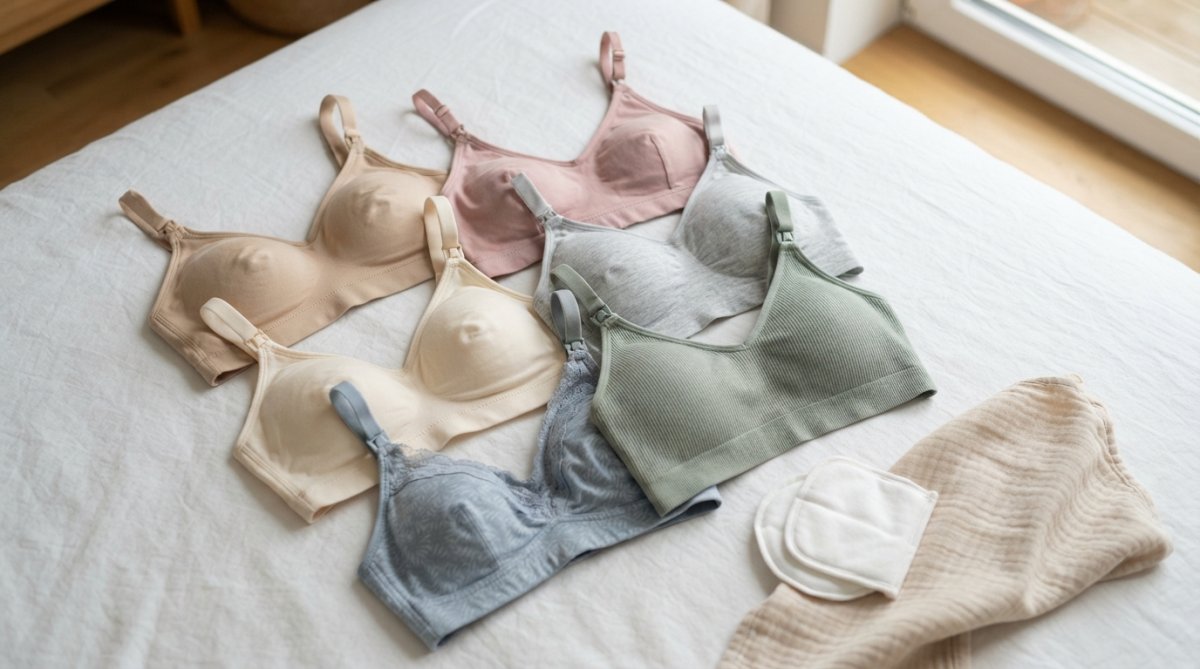
Nine bras, honestly reviewed. Each has a specific purpose, and we've been clear about where each falls short.
| Bra | Price | Wire | Best For | Cup Range |
|---|---|---|---|---|
| Bravado Body Silk Seamless | £30-£34 | Wire-free | Everyday comfort, smooth silhouette | S-XL |
| Royce Blossom | £36-£40 | Wire-free | Versatile styling, changing shape | Multiple |
| Seraphine Bamboo 2-Pack | £35 | Wire-free | Sensitive skin, eco-conscious | S-XL |
| Emma-Jane 365 | £10-£20 | Wire-free | Budget, day and night wear | Multiple |
| Medela Comfy | £22-£26 | Wire-free | Gentle adaptability, everyday | S-XL |
| Cake Maternity Waffles | £60-£70 | Flexible wire | Shape, lift, t-shirt friendly | Multiple |
| Boob Design Fast Food Sports | £62-£79 | Wire-free | Active mothers, sports | Multiple |
| Hotmilk Lunar Eclipse | Around £40 | Wire-free | Large busts, D-H cups | D-H |
| M&S Flexifit Full Cup | £22-£29 | Wire-free | Affordable, wide size range | Up to 42H |
1. Amelie Devizes Expert Fitting Service, Before You Buy Anything
A professional fitting changes everything. Amelie Devizes offers expert, personalised bra fitting services in a warm and inclusive boutique environment, which is especially valuable for mothers whose size is shifting rapidly. Getting professionally fitted means you buy the right bra the first time.
2. Bravado Designs Body Silk Seamless Nursing Bra
The Bravado Body Silk is widely recommended, and deservedly so. Its four-way stretch fabric adapts to fluctuating breast size throughout the day, which is useful in early weeks when engorgement shifts your cup size between morning and evening. One-handed nursing clips keep things manageable. The limitation: this bra is sized S-XL rather than by traditional bra sizing, so fit can be approximate. Mothers with very large busts may find it too loose in the band.
Best for: Everyday wear and a smooth look under clothing. Price: £30-£34
3. Royce Blossom Nursing Bra
The Royce Blossom solves a problem most nursing bras ignore: versatility. An adjustable centre front means it can be worn as a crop top or adjusted to a plunge neckline. Triple cup sizing accommodates engorgement better than most non-wired options. It requires hand washing and offers less structure than padded options.
Best for: Mothers wanting styling flexibility alongside nursing function. Price: £36-£40
4. Seraphine Bamboo Soft Seamless Maternity & Nursing Bra 2-Pack
Bamboo viscose is hypoallergenic, moisture-wicking, antibacterial, and temperature-regulating, all important when dealing with leakage and sensitive skin. The 2-Pack offers two bras at excellent value, and seamless construction prevents rubbing. Bamboo bras offer light support; mothers with larger busts will find this comfortable but insufficient for all-day structure.
Best for: Sensitive skin, eco-conscious mothers, and comfortable loungewear. Price: £35 for two
5. Emma-Jane 365 Non-Wired Nursing Bra
The most affordable option and, for many mothers, the most practical. The Emma-Jane 365 is seam-free, non-wired, and designed for both day and night use. Four adjustment clips at the back give it a longer useful life as your body changes. It will not win awards for shaping or aesthetics, but as a workhorse nursing bra that you can sleep in, wear under anything, and wash repeatedly, it earns its place in every nursing mother's drawer.
Best for: Budget-conscious mothers needing a reliable, versatile everyday bra. Price: £10-£20
6. Medela Comfy Maternity & Nursing Bra
Medela's clinical understanding of nursing needs shows in this design. The extra-stretchy underbust band accommodates ribcage expansion, and one-handed clips work smoothly. Removable foam cups offer discretion for leakage. Support is lighter than structured options, a trade-off with seamless wire-free designs.
Best for: Gentle, adaptable everyday support, especially for Medela pump users. Price: £22-£26.50
7. Cake Maternity Waffles 3D Spacer Nursing Bra
This is the bra for mothers who refuse to sacrifice shape. The 3D spacer foam cups create a smooth, t-shirt-ready silhouette while remaining breathable, and the flexible wire provides lift without traditional underwire rigidity. An internal A-frame sling adds support during feeding. Five hook-and-eye options adapt as your ribcage changes. It requires hand washing and is the most expensive wire-containing option.
Best for: Shape, lift, and a polished look under clothing. Price: £60-£70
8. Boob Design Fast Food Soft Sports Nursing Bra
Active mothers have historically been poorly served by nursing bras. The Boob Design Fast Food Sports Bra addresses that gap. A racerback design and double-layer bust panel provide low-to-medium impact support, and smart clips allow nursing access without removing the bra. The moisture-wicking fabric is made from recycled polyamide and polyester. Synthetic fabric is less breathable than natural fibres for everyday wear.
Best for: Active mothers needing nursing access during and after exercise. Price: £62-£79
9. Hotmilk Lunar Eclipse Wire-Free Nursing Bra
One of the few nursing bras designed for larger cup sizes, the Hotmilk Lunar Eclipse delivers structured support through four-piece cups and six rows of hook-and-eye fastening. Cotton-lined cups are gentle on sensitive skin. Magnetic nursing clips are the fastest one-handed access available. Note: magnetic clips are not suitable for mothers with pacemakers or defibrillators.
Best for: D-H cup mothers needing strong wire-free support with easy nursing access. Price: Around £40
10. M&S Flexifit Non-Wired Full Cup Nursing Bra
M&S Flexifit technology means the bra moves with your body rather than against it. An inner cotton sling provides support during nursing, and four hook-and-eye fastenings accommodate back changes. The size range extends to 42H, making this one of the most inclusive options. Some sizes can be difficult to find in stock.
Best for: Wide size range, accessible price, comfortable daily wear. Price: £22-£29
Best Nursing Bras for Large Breasts: D Cup and Above
Finding nursing bras for large breasts is harder than it should be. Many top out at D or DD cup, leaving women with larger busts with limited options that often sacrifice support for nursing function.
Prioritise: full coverage cups, multiple hook-and-eye rows (four or more), wide and cushioned straps, and structured cup construction such as four-piece cups or internal slings.
The strongest options for large breasts are:
- Hotmilk Lunar Eclipse: Specifically designed for D-H cups. Four-piece cups, six hook-and-eye rows, full coverage.
- M&S Flexifit Full Cup: Sizes to 42H, inner cotton sling, widely available.
- Cake Maternity Waffles: Flexible wire and 3D spacer cups provide shape and lift that wire-free options cannot match for heavier breasts.
- Royce Blossom: Triple cup sizing and adjustable front accommodate engorgement.
According to La Leche League GB on bra fitting and breastfeeding, mothers with larger busts should ensure their bra does not restrict milk flow and check regularly that no areas of the breast feel hard or tender after feeding.
Eco-Friendly and Sustainable Fabric Choices
Bamboo viscose (Seraphine) is soft, hypoallergenic, and biodegradable. Manufacturing involves chemical treatment, but it performs better than conventional synthetics on skin sensitivity and temperature regulation.
Recycled nylon (Bravado Designs, Boob Design) reduces reliance on virgin petroleum-based materials. These are credible sustainability claims rather than greenwashing.
Organic cotton is the most straightforward eco-friendly choice. Cotton-lined cups offer breathability and skin safety even when the outer fabric is synthetic.
Look for OEKO-TEX Standard 100 certification (tested for harmful substances) and GOTS certification (organic textile production). According to WRAP's guidance on sustainable clothing, choosing durable, well-made garments and washing at lower temperatures has greater environmental impact than fabric choice alone.
Bra-Related Health Issues to Watch For During Nursing
Ill-fitting nursing bras can contribute to several health issues that are uncomfortable and sometimes serious.
Blocked milk ducts: Occur when milk cannot drain freely from part of the breast. A bra that is too tight, has a band sitting on breast tissue, or has an underwire pressing incorrectly can all contribute. Signs include a hard, tender lump and localised redness.
Mastitis: Inflammation of breast tissue, sometimes caused by a blocked duct that becomes infected. Symptoms include flu-like aches, fever, and a red, hot area. The NHS guidance on mastitis recommends continuing to breastfeed or express milk from the affected breast and seeking GP advice if symptoms do not improve within 12-24 hours.
Shoulder and back pain: A poorly fitting nursing bra that sits too loose in the band transfers breast weight to the straps and shoulders. This is entirely avoidable with correct fitting.
Skin irritation and thrush: Synthetic fabrics that trap moisture, combined with leakage from nursing pads, can create conditions for fungal infections. Cotton-lined cups and breathable outer fabrics reduce this risk.
The fitting principle that matters most: The band does the work. If your band is riding up at the back, it is too loose. A loose band means your straps compensate, leading to shoulder pain and poor support. Tighten the band before the straps.
Which Nursing Bra Should You Choose?
The right nursing bra depends on three things: your cup size, your lifestyle, and where you are in your breastfeeding journey.
- Early postpartum (weeks one to six): Choose maximum adjustability. The Bravado Body Silk, Medela Comfy, or Emma-Jane 365 all handle fluctuating size well.
- D+ cups at any stage: Start with the Hotmilk Lunar Eclipse or M&S Flexifit Full Cup.
- Active mothers: The Boob Design Fast Food Sports Bra is the only option designed for movement.
- Eco-conscious mothers: Seraphine Bamboo 2-Pack or Bravado Eco-Adapt.
- Shape under clothing: Cake Maternity Waffles.
- Budget: Emma-Jane 365 at £10-£20 is the most honest value on this list.
If you are unsure, a professional fitting removes the guesswork entirely. The Amelie Devizes team offers personalised bra fitting in a welcoming, non-judgmental environment, particularly valuable during the postpartum period when your body is changing quickly and confidence matters.
Frequently Asked Questions
Is a maternity bra the same as a nursing bra?
Maternity bras are designed for comfort during pregnancy, accommodating growing breast tissue and a expanding ribcage. Nursing bras add drop-down cups or easy-access clips so you can breastfeed without removing the bra. Many modern designs serve both purposes, making them a practical choice from the third trimester through the full breastfeeding period. If budget is a consideration, a dual-purpose maternity and nursing bra offers the best value across both stages.
When should I start wearing a nursing bra?
Most fitters recommend buying your first nursing bra around weeks 36 to 38 of pregnancy, when your size is relatively stable. However, breast engorgement after birth can increase your cup size by one to two sizes, so look for bras with adjustable straps, multiple hook-and-eye closures, and stretchable cup fabric. Some mothers find a soft lounge bra or seamless style comfortable from the second trimester onwards, particularly if their existing bras feel tight or restrictive.
How many nursing bras do I need for the first few weeks?
Three to five nursing bras is a practical starting point. Leakage, frequent washing, and daily wear mean you will cycle through them quickly. Having at least one wire-free bra for night feeds, two comfortable maternity bras for nursing during the day, and a spare for washing days is a sensible minimum. Add a sports nursing bra if you plan to return to exercise. A professional fitting before you buy helps avoid costly mistakes if sizes change postpartum.
What should I look for in the best nursing bras for large breasts?
For D cup and above, prioritise bras with full-coverage cups, a wide supportive band, and multiple rows of hook-and-eye fastenings to accommodate ribcage fluctuation. Four-piece cups offer better shaping than a single-piece design. Look for wide, adjustable straps that distribute weight across the shoulders. Wire-free options with an internal sling or structured cup, such as those with 3D spacer foam, give meaningful support without the pressure on milk ducts that a standard underwire can create.
Can wearing the wrong bra cause problems during breastfeeding?
Yes. A bra that is too tight, particularly one with rigid underwiring, can compress breast tissue and restrict milk flow, increasing the risk of blocked ducts and mastitis. Poorly fitting straps that dig in can also cause shoulder and upper back discomfort. Conversely, a bra with insufficient support can contribute to breast pain and poor posture. Getting a professional fitting, especially after birth when your size has settled, significantly reduces these risks and improves daily comfort.
Finding comfortable maternity bras for nursing is easier when you have expert guidance alongside the right products. Amelie Devizes offers personalised bra fitting services and a carefully curated selection of nursing and maternity lingerie, so you can find a fit that genuinely supports you through every stage of your breastfeeding journey. Visit ameliedevizes.co.uk to shop all products or book your fitting.
This article was written using GrandRanker