

Why You Need a Bra Fitting After Pregnancy
Table of Contents
- Why Your Body Needs a New Fit
- When to Buy Nursing Bras: Timing Your Fit
- 5 Signs Your Bra Doesn't Fit After Pregnancy
- The Benefits of Professional Bra Fitting
- What to Expect from Your Bra Fitting After Pregnancy
- Common Fitting Mistakes and How to Avoid Them
- Book Your Postnatal Fitting Today
- Frequently Asked Questions
Last Updated: September 8, 2026
Pregnancy changes your body in ways that linger long after delivery, and your bra size is one of the most significant transformations. A bra fitting after pregnancy is not a luxury; it is a necessity for your comfort, posture, and long-term breast health. Below, we will show you exactly how your body changes, when to book your fitting, and what to expect from the process.
Why Your Body Needs a New Fit
The transformation of your breasts across pregnancy, breastfeeding, and weaning is not a single event but a continuous process, and each stage demands different support. Understanding the underlying physiology explains why your pre-pregnancy bras simply cannot do the job.
The Mechanics of Change
During pregnancy, hormonal shifts, particularly oestrogen and progesterone, stimulate the growth of milk ducts and glandular tissue. This begins as early as the first trimester, which is why many women experience breast tenderness and growth before their bump is even visible. Simultaneously, your ribcage expands. The hormone relaxin, which loosens ligaments throughout the body to prepare for childbirth, also affects the connective tissue around your ribs (peer-reviewed research). This expansion often amounts to a full band size or more, and crucially, it does not fully reverse after delivery.
As your pregnancy progresses, the Cooper's ligaments, the fibrous tissue that supports the breast's structure, stretch to accommodate the increased weight. Unlike muscle, these ligaments have limited elasticity. Once overstretched, they do not return to their original length, leading to a permanent change in breast shape and firmness. This is not a flaw in your body; it is a natural consequence of the remarkable work it has done.
The Post-Weaning Transition: The Missing Chapter
Most advice stops at breastfeeding, but the most significant changes often occur after you wean. When you stop nursing, the glandular tissue that expanded to produce milk begins to shrink and is gradually replaced by fatty tissue (PubMed). This process, known as involution, can take several months and leads to a noticeable reduction in cup volume. Many women describe their breasts as feeling 'deflated' or less dense during this period.
This post-weaning phase is when your bra size is most likely to change again, often dropping several cup sizes from your nursing size but rarely returning to your pre-pregnancy dimensions. The skin may also have lost elasticity, meaning the breast needs more structural support from a bra, not less. A fitting at three to six months post-weaning is essential to address this new reality, yet it is the fitting most women never have. This is the fitting that provides the long-term support your breasts need for the decades ahead, not just the months of active feeding.
The Risk of Doing Nothing
Wearing an ill-fitting bra during these transitions is not merely uncomfortable. The weight of unsupported breast tissue can pull on the shoulders and upper back, potentially contributing to discomfort. Furthermore, a bra that is too tight across the band can cause discomfort.
A professional fitting at each of these milestones is not about vanity; it is about providing the appropriate mechanical support for your body as it navigates these profound physiological changes.
When to Buy Nursing Bras: Timing Your Fit
The ideal time for your first bra fitting after pregnancy is around week 36 to 38 of pregnancy, when your ribcage has reached its fullest expansion. At this stage, a maternity bra fitted correctly will accommodate the final weeks of pregnancy and the early postpartum period.
Your milk supply typically arrives two to five days after delivery, causing rapid breast engorgement (the CDC). Many women find their cup size fluctuates significantly during the first six weeks postpartum as supply regulates. A second fitting around week six to eight after birth is advisable, as your size will have stabilised somewhat.
| Fitting Stage | Timing | Purpose |
|---|---|---|
| First fitting | Weeks 36-38 of pregnancy | Buy nursing bras for hospital and early postpartum |
| Second fitting | 6-8 weeks after delivery | Adjust for regulated milk supply and settling ribcage |
| Third fitting | 3-6 months post-weaning | Address permanent breast tissue changes |
5 Signs Your Bra Doesn't Fit After Pregnancy
The most obvious sign that you need a bra fitting after pregnancy is red marks or indentations left on your skin after removing your bra. These indicate the band or wires are digging into tissue, which can restrict milk flow and cause discomfort.
Other clear indicators include:
- The centre gore does not lie flat against your sternum
- Your breasts spill over the top or sides of the cups
- The band rides up your back, meaning it is too loose
- Shoulder straps dig in deeply, carrying weight the band should support
Many mothers also report new back pain, neck pain, or posture problems during feeding. A bra that no longer provides proper support forces your shoulders and upper back to compensate, which leads to muscle fatigue and poor posture over time.
The Benefits of Professional Bra Fitting
A professional fitting is not a luxury shopping experience; it is a health intervention that addresses both the physical and psychological toll of the postpartum period. While a home tape measure can give you a starting point, it cannot account for the complex, three-dimensional reality of your post-pregnancy body.
Beyond the Tape Measure: Tissue Health and Milk Flow
The primary benefit of a specialist fitting is ensuring appropriate support for your breast tissue. A fitter assesses not just your band and cup size, but also considers the shape, density, and distribution of your breast tissue to find the best fit.
During lactation, a bra with a band that is too tight or cups that compress the breast can cause discomfort. A professional fitter ensures the underwire, if you choose a wired style, sits in the inframammary fold, clear of the breast tissue itself, to provide comfort and support. The fitter will also check the centre gore, which should lie flat against your sternum to provide proper structure.
The Psychological Dimension: Restoring Confidence
The physical support of a well-fitted bra has a direct impact on mental well-being. In the postpartum period, when many women feel disconnected from their bodies, wearing a bra that fits correctly can be a profound psychological boost. It restores a sense of control and normalcy. You stand taller, move with more confidence, and no longer spend the day adjusting straps or pulling down a riding-up band.
A specialist fitting acknowledges that your body has changed and provides a solution that honours that change, rather than trying to squeeze you back into a pre-pregnancy shape. This validation is often as important as the physical support. Many mothers report feeling a wave of relief, and sometimes emotion, when they finally wear a bra that does not dig in, spill over, or require constant adjustment. It is a small but significant step toward feeling like yourself again.
What a Specialist Fitter Does Differently
Unlike a quick high-street measurement, a professional fitting is a dialogue. The fitter will ask about your breastfeeding journey, your daily activities, and your comfort preferences. They will observe how you move, not just how you stand. They will bring in multiple styles, wire-free, wired, full-cup, balcony, and explain the trade-offs of each. They will also advise on how to adjust the bra as your size fluctuates throughout the day with milk production, recommending styles with stretchy fabric or adjustable closures that accommodate these natural shifts.
This level of personalised attention helps ensure your bra provides comfortable support, assisting your body through the demands of motherhood.
What to Expect from Your Bra Fitting After Pregnancy
Your bra fitting after pregnancy at a specialist boutique should take around 30 to 45 minutes and feel comfortable, never rushed. The fitter will begin by measuring your band size and cup size, then bring a selection of bras suited to your shape and needs. You will try several styles, and the fitter will check the fit from every angle, adjusting straps and closures as needed.
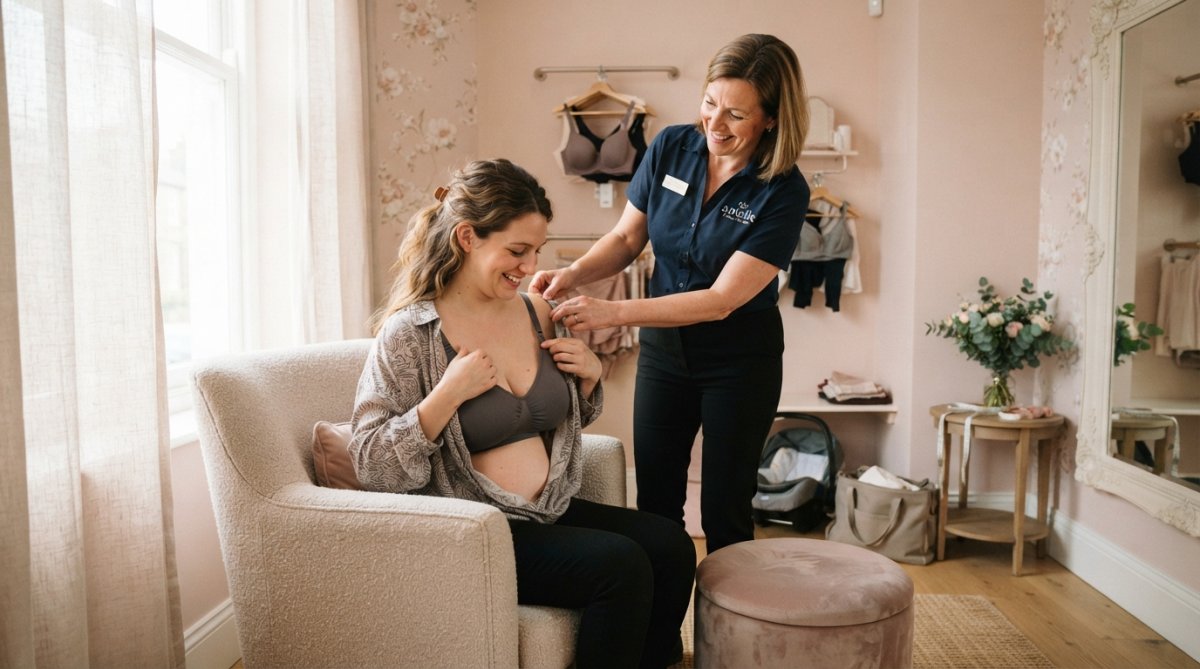
Expect honest guidance on whether you need a maternity bra, a nursing bra, or both. A maternity bra offers support during pregnancy, while a nursing bra features drop-down cups for breastfeeding access. The fitter should also discuss how your size may continue to change, helping you avoid buying too many bras at once. Many women find the experience emotional, as it is often the first time they have felt properly supported since pregnancy.
Common Fitting Mistakes and How to Avoid Them
The most common mistake is delaying your fitting until after you have stopped breastfeeding. By then, months of poor support may have caused discomfort. Another frequent error is buying a bra with underwire when many modern wire-free options provide excellent support.
Some mothers also buy several nursing bras in the same size early on, only to find their cup size changes as their milk supply regulates. A better approach is to purchase two or three well-fitted bras initially, then return for a reassessment once your supply has settled. For those seeking sustainable options, many brands now offer nursing bras made from organic cotton or recycled materials, which are gentler on sensitive skin and the environment.
Book Your Postnatal Fitting Today
Your body has accomplished something remarkable, and it deserves underwear that honours that achievement. A bra fitting after pregnancy is the first step toward feeling like yourself again, with proper support that eases back pain and restores your confidence. At Amelie Devizes, our expert fitters provide a warm, inclusive environment where you can take your time finding the perfect fit.
We offer a curated selection of high-quality nursing and maternity bras, including the wire-free Triumph Doreen range, designed for everyday comfort and support. Our personalised service ensures you leave with bras that fit beautifully today and adapt as your body continues to change. Book your appointment with Amelie Devizes and experience the difference a truly tailored fitting makes.

Frequently Asked Questions
How soon after giving birth should I get a professional bra fitting?
Book a fitting within the first two weeks after delivery, once your milk supply has settled. Your ribcage and breast tissue change dramatically in the days following birth. A professional fitting after pregnancy ensures your bra supports these changes correctly, prevents discomfort, and accommodates breastfeeding. If you're still pregnant, consider a fitting in your third trimester as a starting point.
Can wearing an ill-fitting bra after pregnancy affect my milk supply?
A bra that is too tight can put pressure on your breasts, which may cause discomfort. A properly fitted nursing bra supports your breast tissue without compression, allowing for comfortable feeding. If you notice red patches or a hard lump, booking a fitting to check your bra's fit is advisable.
Do my breasts go back to my pre-pregnancy size after I stop breastfeeding?
Often, they do not. After weaning, breast tissue shrinks, but the Cooper's ligaments may have stretched, leaving a different shape or size. This is a normal part of the postpartum body changes. A bra fitting after pregnancy helps you find a supportive bra for your new shape, which can improve your comfort and support.
What is the difference between a maternity bra and a nursing bra?
Maternity bras are designed for pregnancy when your breasts are growing, offering flexible fabric and no underwire for comfort. Nursing bras are for after delivery, with drop-down cups or clips for breastfeeding access. Both are useful. A professional fitting can help you determine when to switch from a maternity bra to a nursing bra.